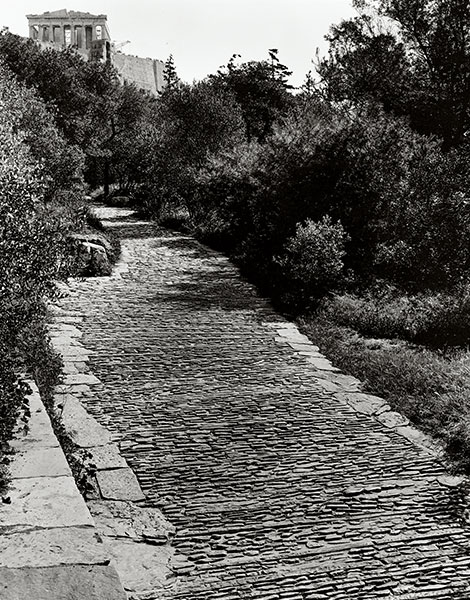
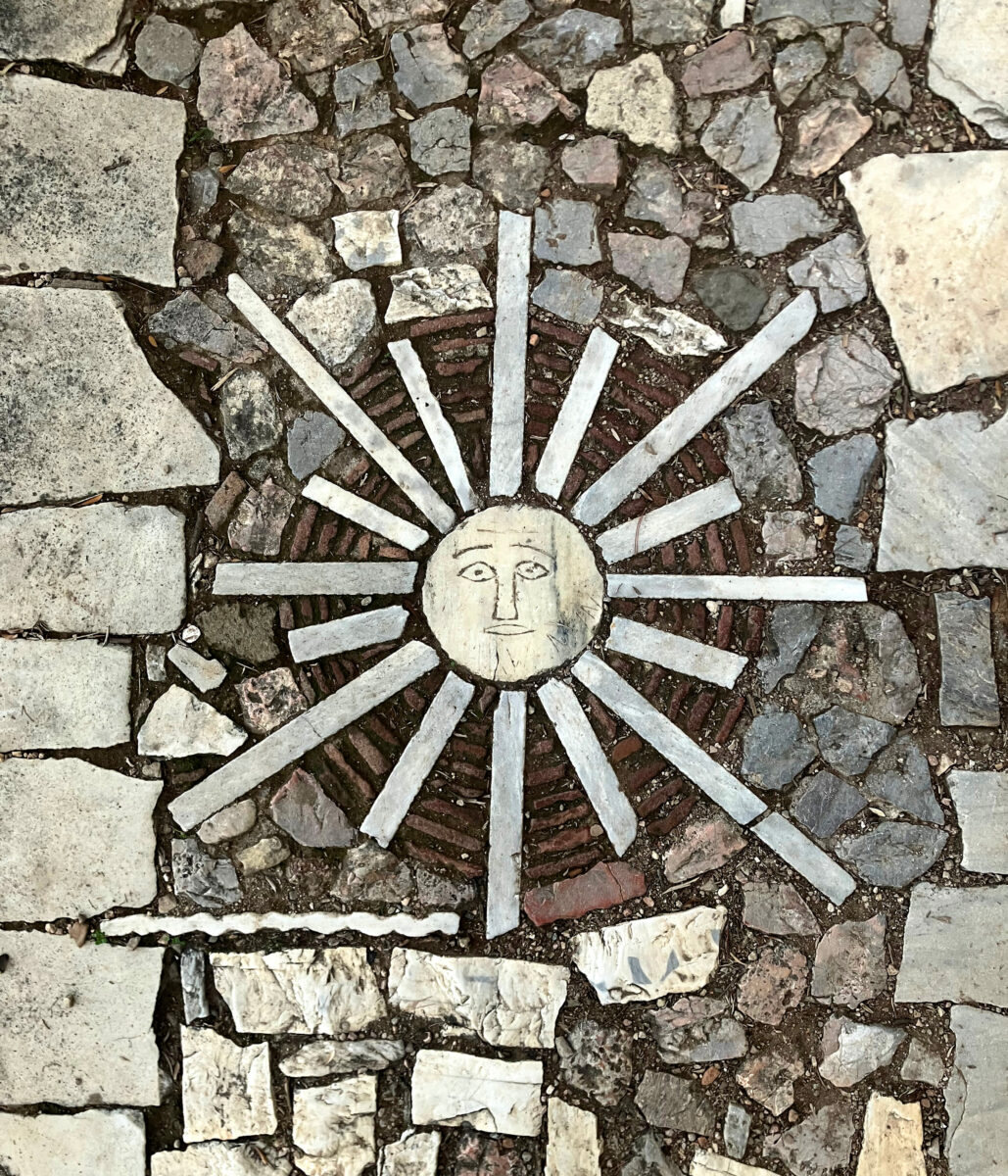
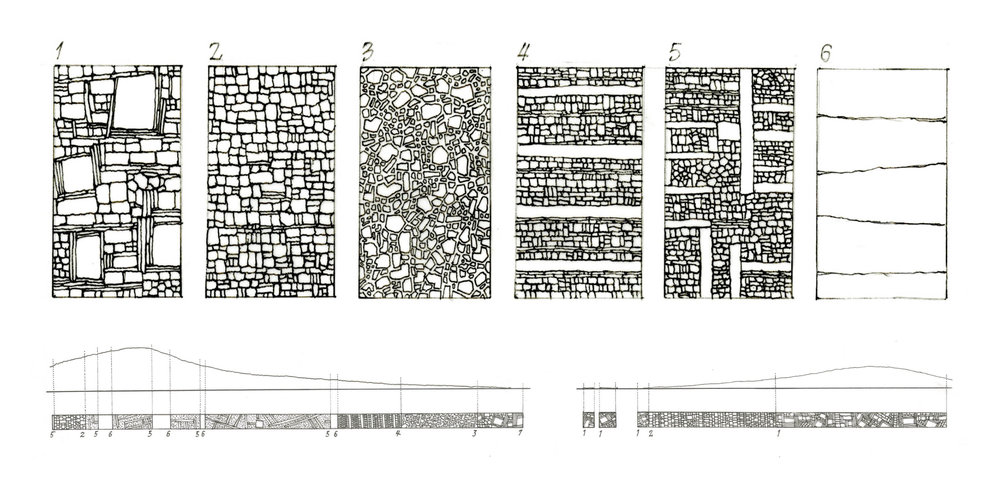
“I stoop and pick up a stone. I caress it with my eyes, with my fingers. It is a piece of grey limestone. Fire molded its divine shape, water sculpted it and endowed it with this fine covering of clay that has alternative patches of white and rust, with a yellow tinge. I turn it around in my hands. I study the harmony of its contours. I delight in the way its hollows and protrusions, light and shadows, balance each other on its surface.”
Dimitris Pikionis
Here I reference the article by Irene Vogel Chevroulet titled: Accepted Manuscript, The paths of gods and architects From Japan to the Acropolis the landscapes of Dimitris Pikionis.
In the article Irene traces the influence that Japanese Gardens, which Pikionis knew from books, photos and articles, influenced Pikionis in his creation of the gardens and paths surrounding the Acropolis.
The Architect Dimitris Pikionis wrote to his client, Konstantinos Karamanlis, the Minister of Transport and Public Works:
“Currently popular forms and currently popular constructions are invalid as far as this project is concerned:
given the aesthetically crucial nature of the site in which the project is being executed, they are alien to it, and it shuns them. Down to the last detail, the architect will have to conceive new forms and revise the modes of construction in use, elevating them to a level of validity inspired by ancient art”
Here, we gather that Pikionis was rejecting modernity
But he was neither promising to recreate anything from the past. “New Forms, …Revised Modes of Construction”. Building within the very shadow of the Temple of Athena, he sought, I believe, to create something both new, and worthy of the ancients.
Perhaps not an attempt to mimic the past, to merely replicate–but to honor the spirit, with a living work.
Again quoting Pikionis:
“This project is very wide-ranging and, of its nature, multi-faceted. It includes elements of town planning, such as streets, the layout of traffic intersections and the construction of car parks. It also includes the construction of stone and paved walkways, retaining walls and boundary walls, custodians’ huts and pavilions, landscaping, the planting of trees and bushes, etc. There is no question but that all features must be harmonized into an entity governed by the same spirit down to the last detail. (…) I ask for one thing only, and it is on that condition that I agree to make my modest contribution. I ask that you safeguard the lawful rights and the responsibilities that stem from them, together with the terms essential for artistic activity to take place, and that these issues be respected by all those working on the project. In this way, creativity will be able – without being bound by coercion, haste or slovenliness of any kind – to express itself in the only manner in which is entitled to express itself, that is, in a spirit of absolute freedom. On that condition, on that condition alone, the fruits of co-operation will be those which are expected”.
Fine words, well said. Tell it on the mountain. The article furthermore states that Pikionis worked with “no time and no budget limit” and submitted no drawings.
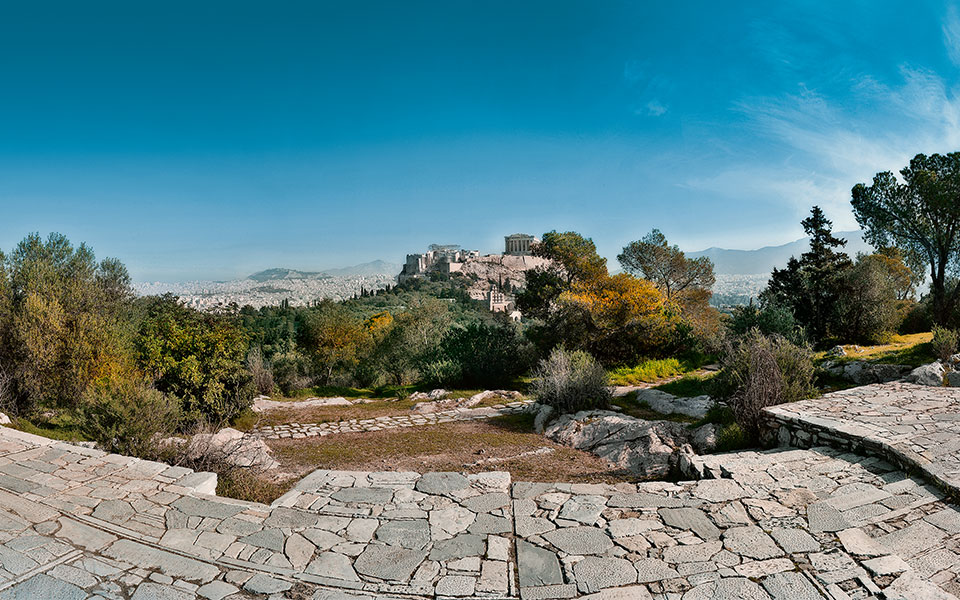
Photo: The landscape surrounding the Acropolis of Athens, designed and overseen by the architect and artist Dimitris Pikionis, 1954 to 1958. Born in 1887 he was 71 when the Acropolis Project was finished. What an epic commission to land, at that age, or any age, building in the environs of the Temple to Athena. I’m processing an article I just reread about him and his approach to this project. May have more to say on the matter later.
Shin Gyo So
The article cited also introduced me to Shin Gyo So, a concept in Japanese arts. Quoting the article:
Traditionally across all arts, the Japanese work with three artistic approaches — shin, gyo and so: perfect, intermediate and rustic — that came originally from Chinese calligraphic styles. The shin style is formal, meticulous, dignified and used for official documents. The gyo style is semi-cursive, freer and more individual. The so style is free, so personal that it can be unreadable. In garden art, approaches determine the finish of materials: perfect, intermediate or rustic. Whether the path is in a temple or a residence, its composition is based on three levels of stone finishing.”
Irene Vogel Chevroulet is a Swiss Scholar of the subjects of Architecture and researcher and lecturer on such matters, especially as related to Japanese Architecture. A friend, who has helped Irene with English translations, introduced me to this work.
The words of Pikionis
have inspired me a bit, as I get more comfortable with the medium and continue to experiment, and begin, in recent years, to bring in a spirit of spontaneity and play. During some of my recent projects I’ve thought a bit about these concepts:
https://www.youtube.com/shorts/X8jixk5qw4I
Planning a Stone Project?
If you’re interested in building a stone feature that works with the natural environment, I provide custom masonry services including flagstone patios, retaining walls, and artistic stonework in Blakeslee, PA and nearby areas.
👉 Contact me to discuss your project
All credit here goes to Irene Vogel Chevroulet and Dimitris Pikionis, any inaccuracy belongs entirely to the present author Devin Devine, contractor based out of
Blakeslee Pennsylvania, projects competed across the USA
contact devin@devineescapes.com