This lexicon explores terminology related to dry stone masonry, land art, stone sculpture, vernacular architecture and natural material craft traditions. Definitions range from traditional masonry terminology to contemporary concepts connected to stone art and landscape-based sculpture, especifically as related to the work of Devin Devine, artist and artisan contact devin@devineescapes.com
an Architectural and Nature Art vocabulary from A to Z
Angle of Repose
If you pile up some sand, it will form a cone-like mound. Rounder soils may have a lower angle of repose. Angular materials will have a steeper angle of repose.
Arch
Stones, arranged in a manner so that they fly over the ground, and support each other in such a flying endeavor.
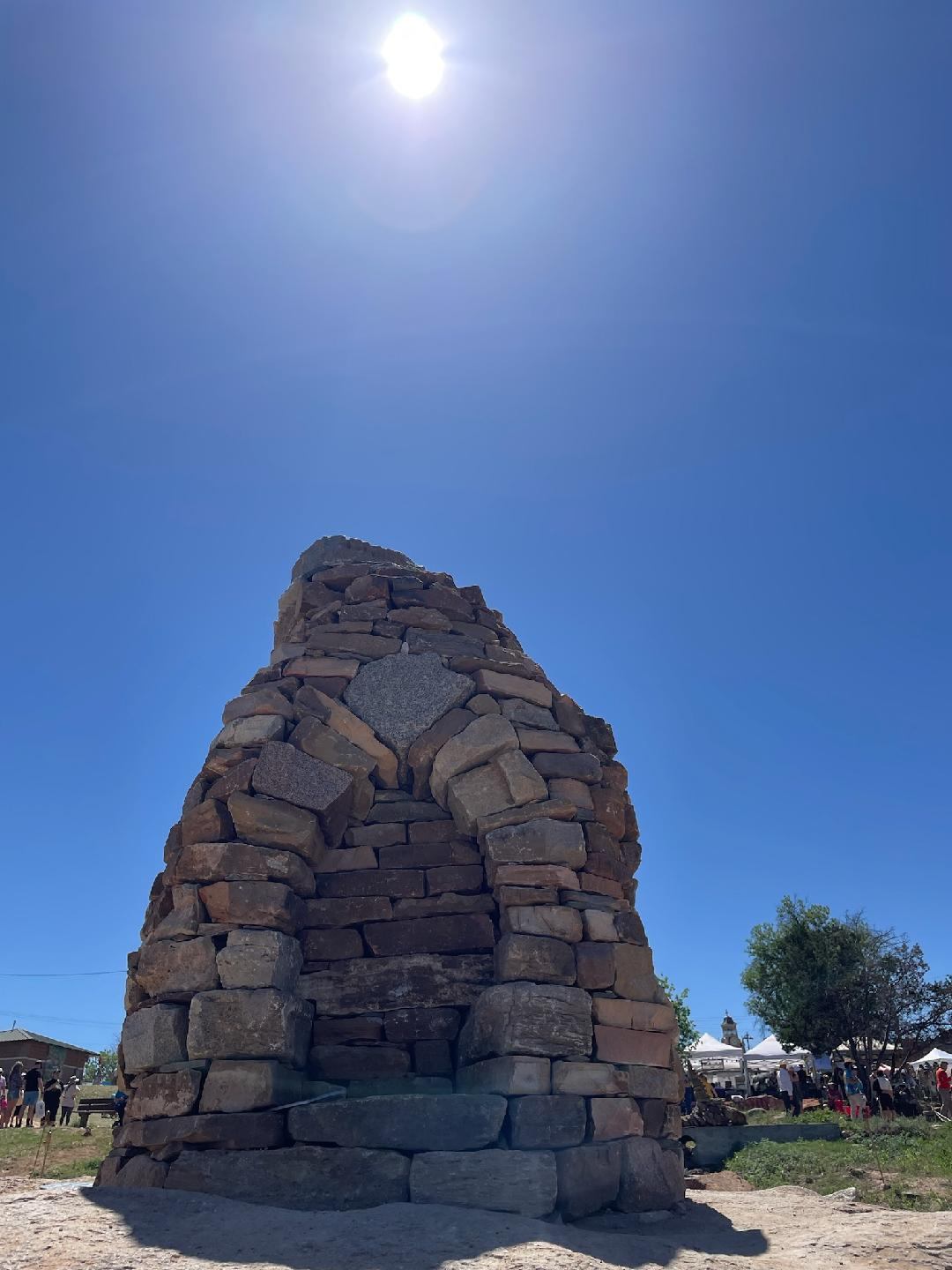
Arch, the magically flying stones. Could be a bridge, a window or a door way. Festival Installation Art.
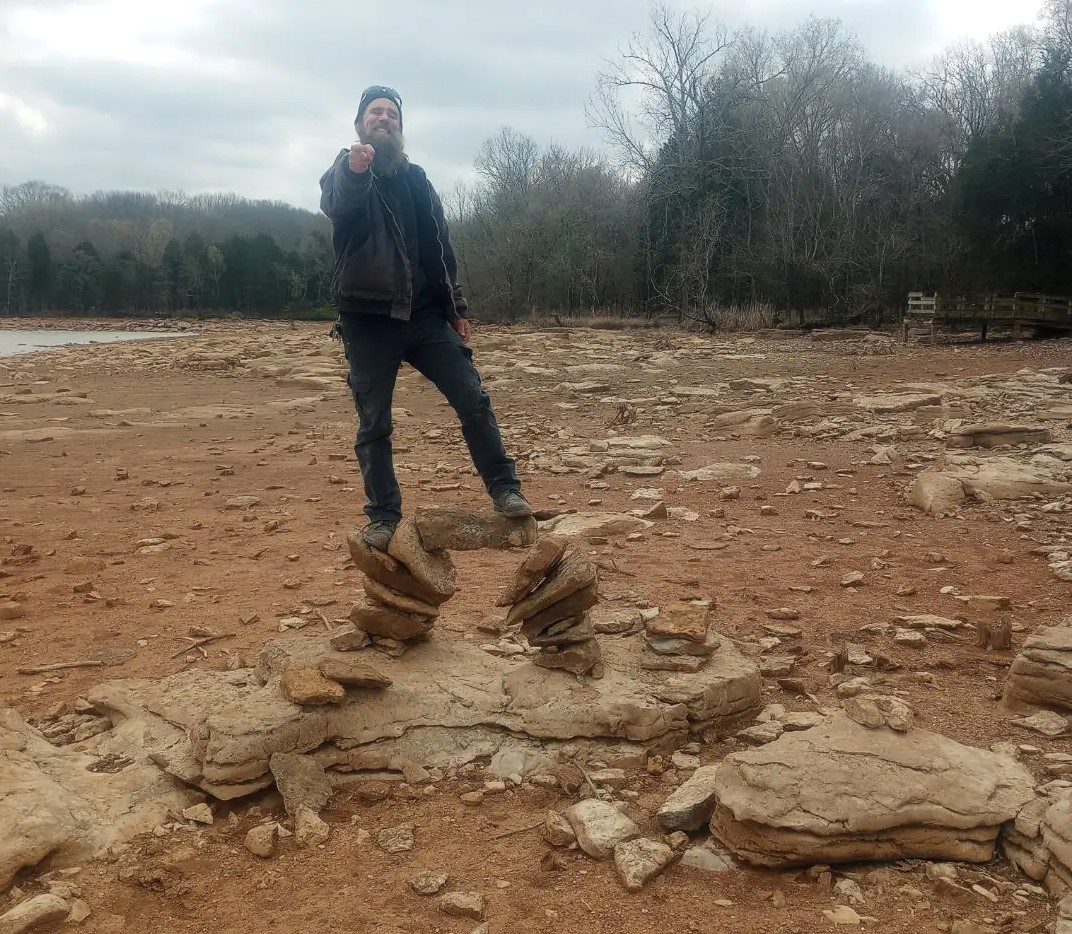
Ephemeral arches are popular amongst some contemporary land artists. What I don’t get though–is how do you build a thing, without also climbing it? This arch, though only taking 5 minutes to build–still passed the strength test.
Balance
2 or more stones placed with one atop the other, in a non structural manner. Often, this is done as a sort of meditation.
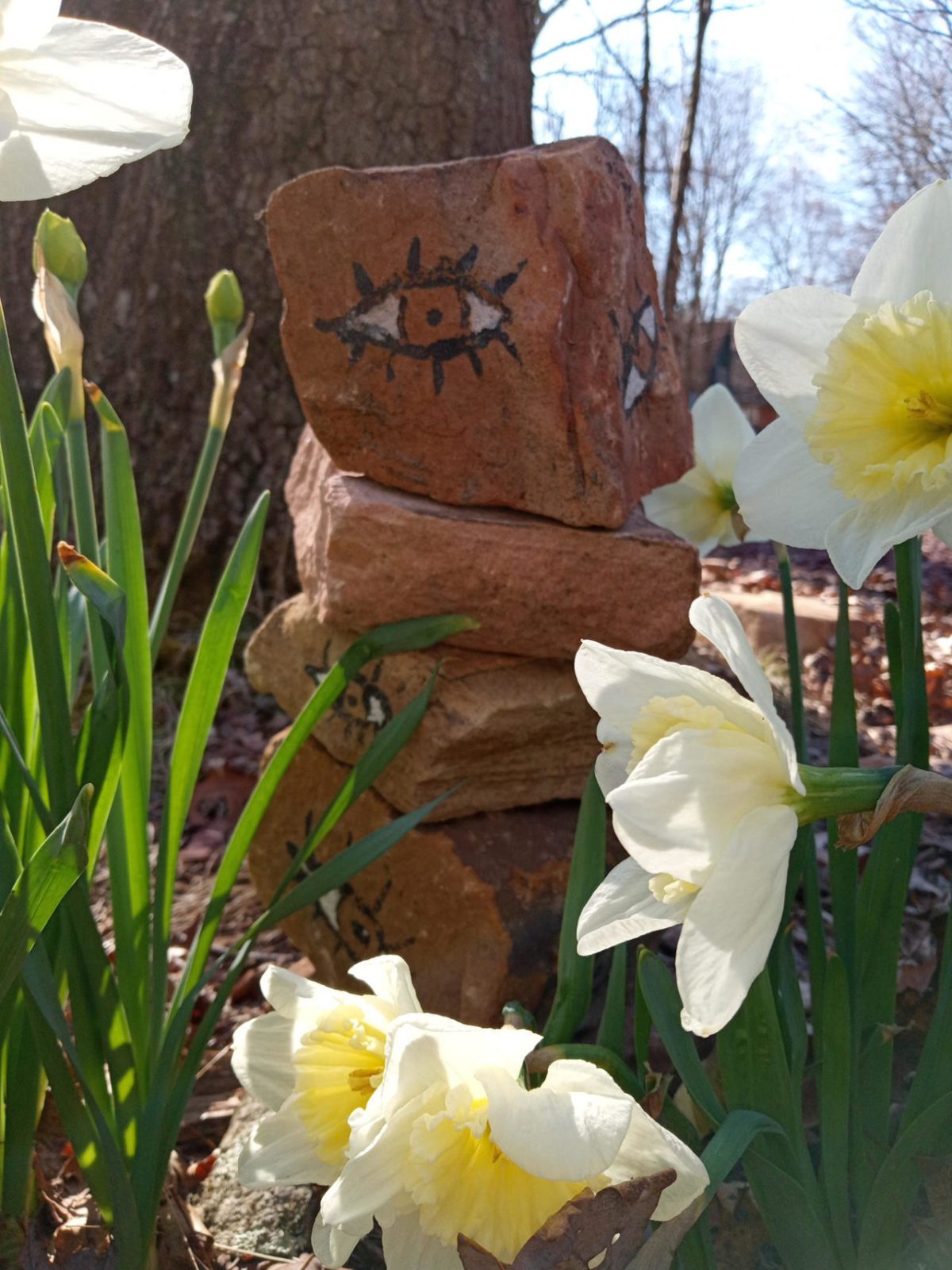
Your present author hasn’t big been into balancing much, but had a brief fascination in 2006 and 2007.
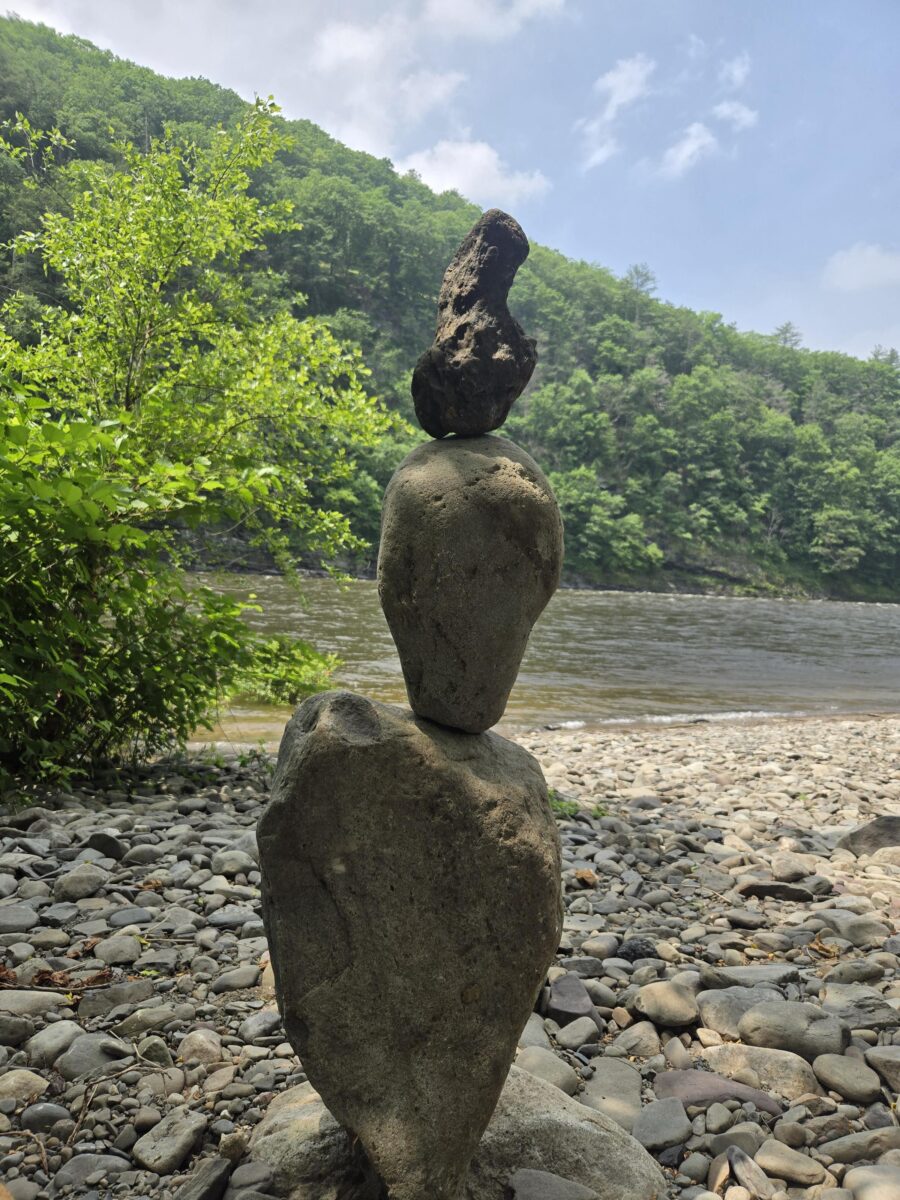
Created at NEBG the North East Balance Gathering
Batter
Dry stone walls are built with a taper. The base of the wall is wider than the top.
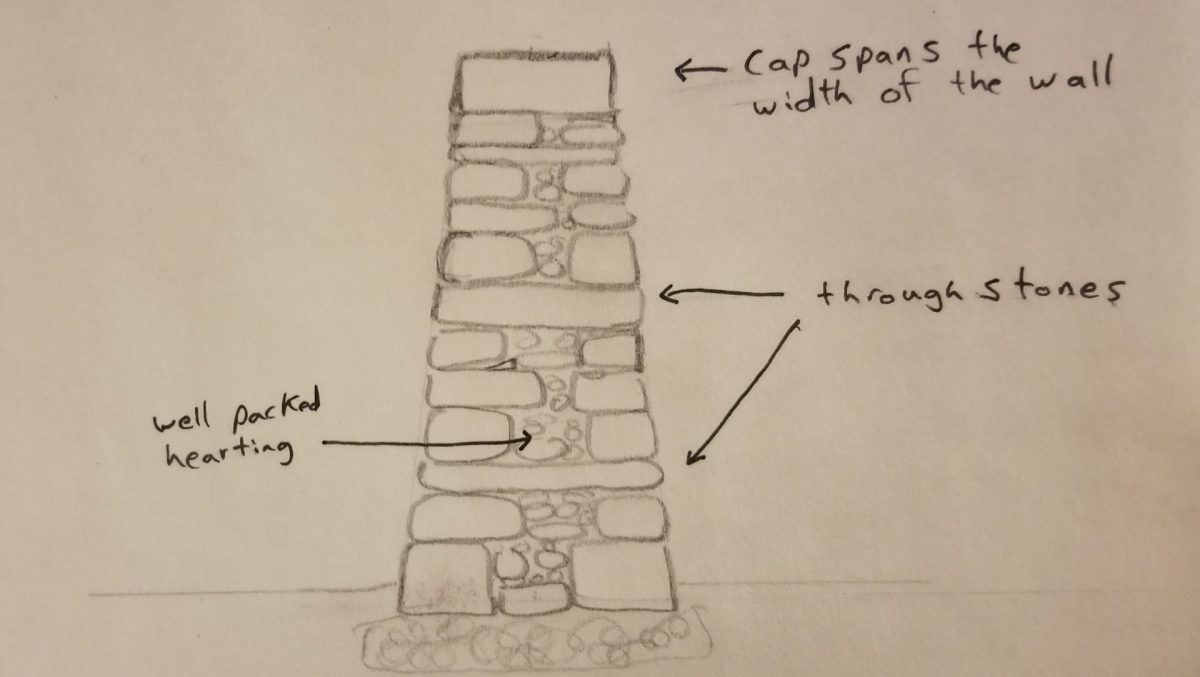
dry stone wall cross-section/diagram
Bench
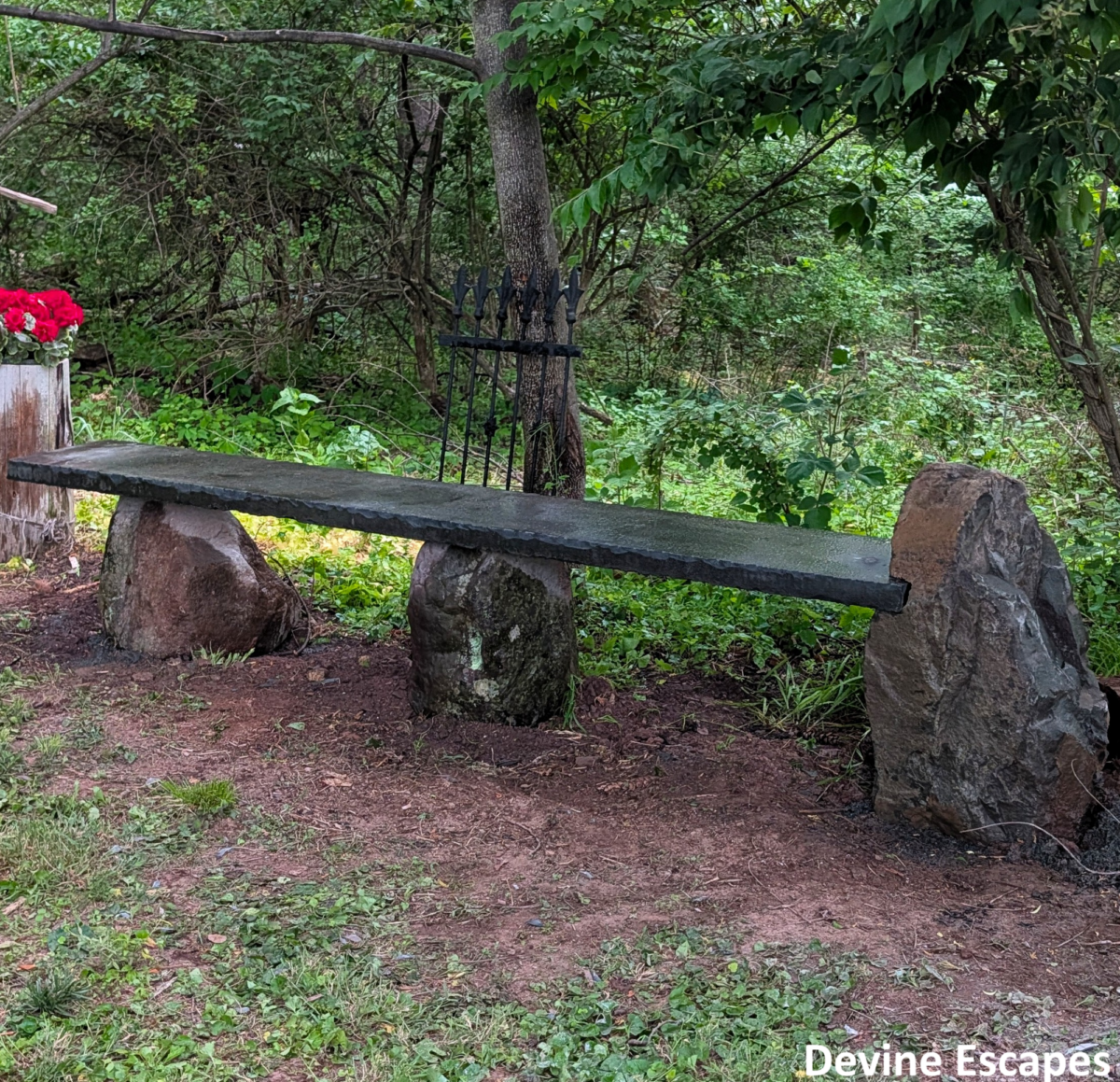
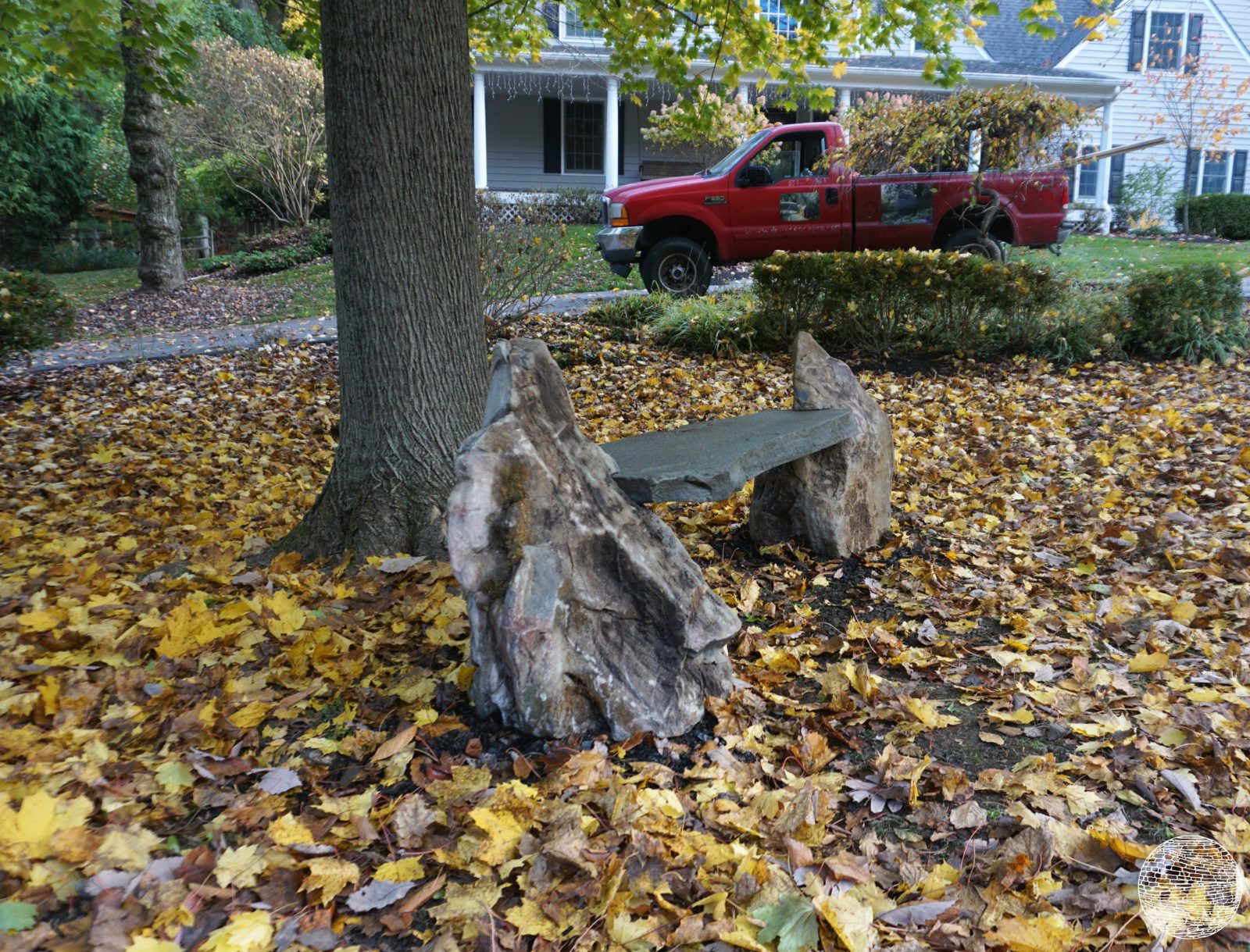
This stone bench was delivered a bit closer to home: to Collegeville PA
Bird Bath
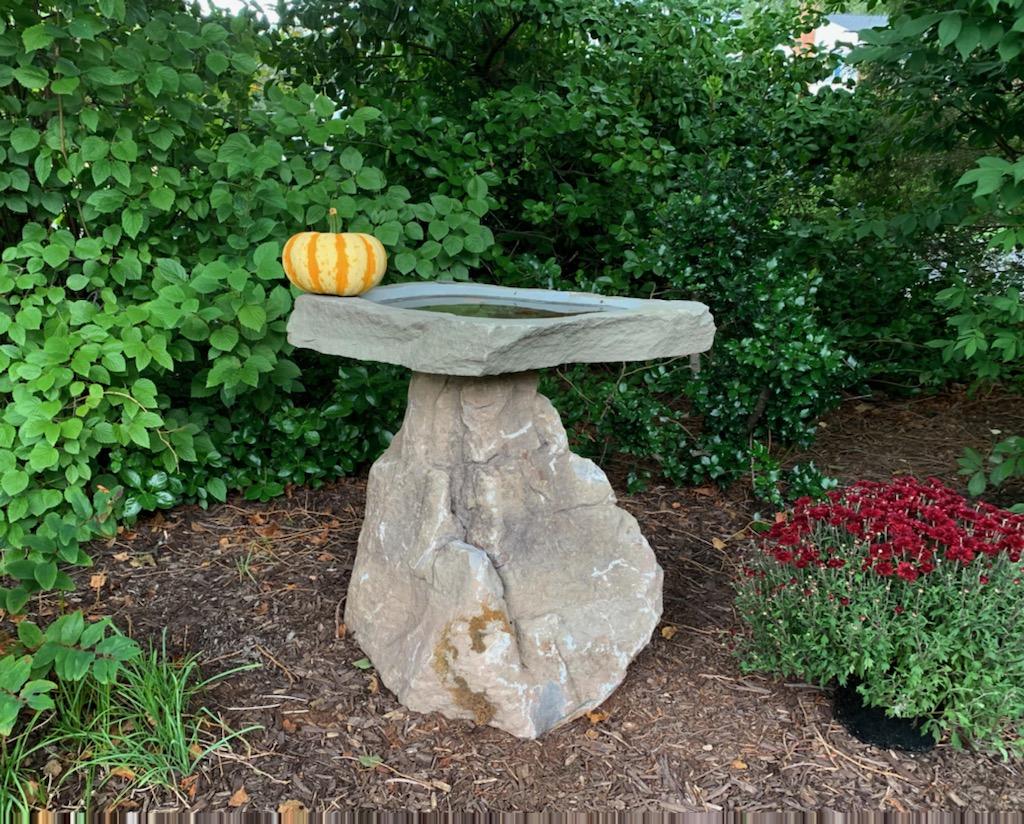
Natural stone bird bath, mossy Pocono boulder and Pennsylvania Bluestone top
Bond
For stacked materials, bond refers to the orientation of the vertical joints in any stacked material. For example, bricks and blocks are often stacked on half-bond.
Cairn
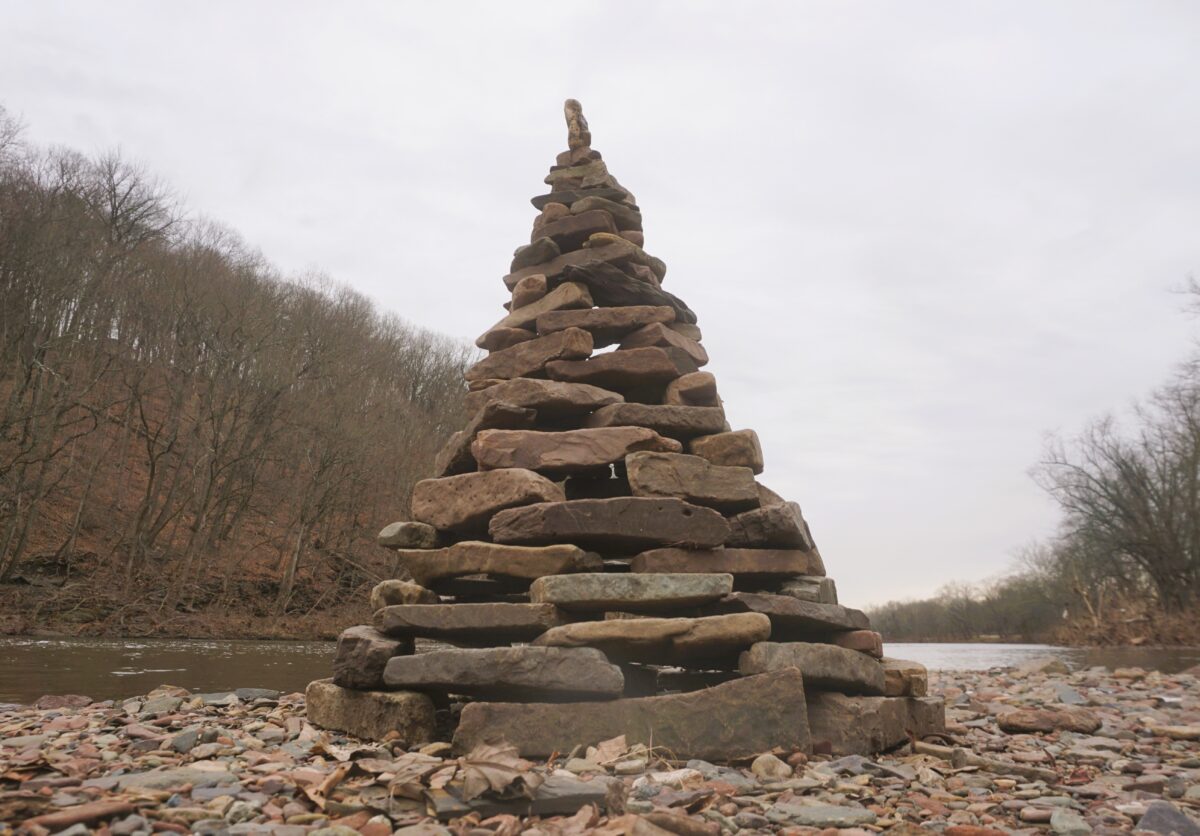
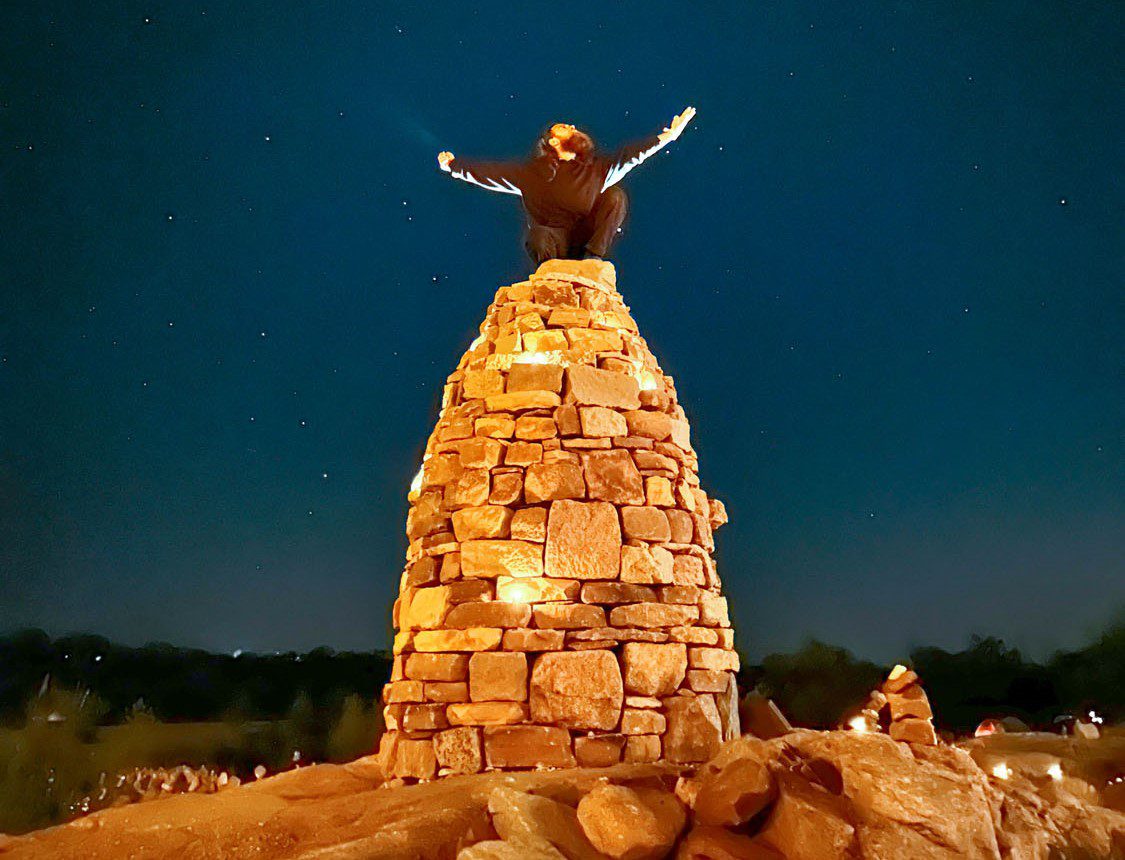
Stones stacked atop each other as a trail marker, or a grave site. In either case, the purpose of the cairn is to mark a site. In recent years, rock balances have been called cairns, and there exists some overlap between these two. Generally, a balance is kick-over-able. But some land artists and rock balancers may arrange more complicated balances, that begin to resemble a traditional rock cairn. Cairns may also be arranged as temporary storage for stone, for fun, for practice, and for experimentation with composition–in preparation for more permanent artistic builds.
Candle holder
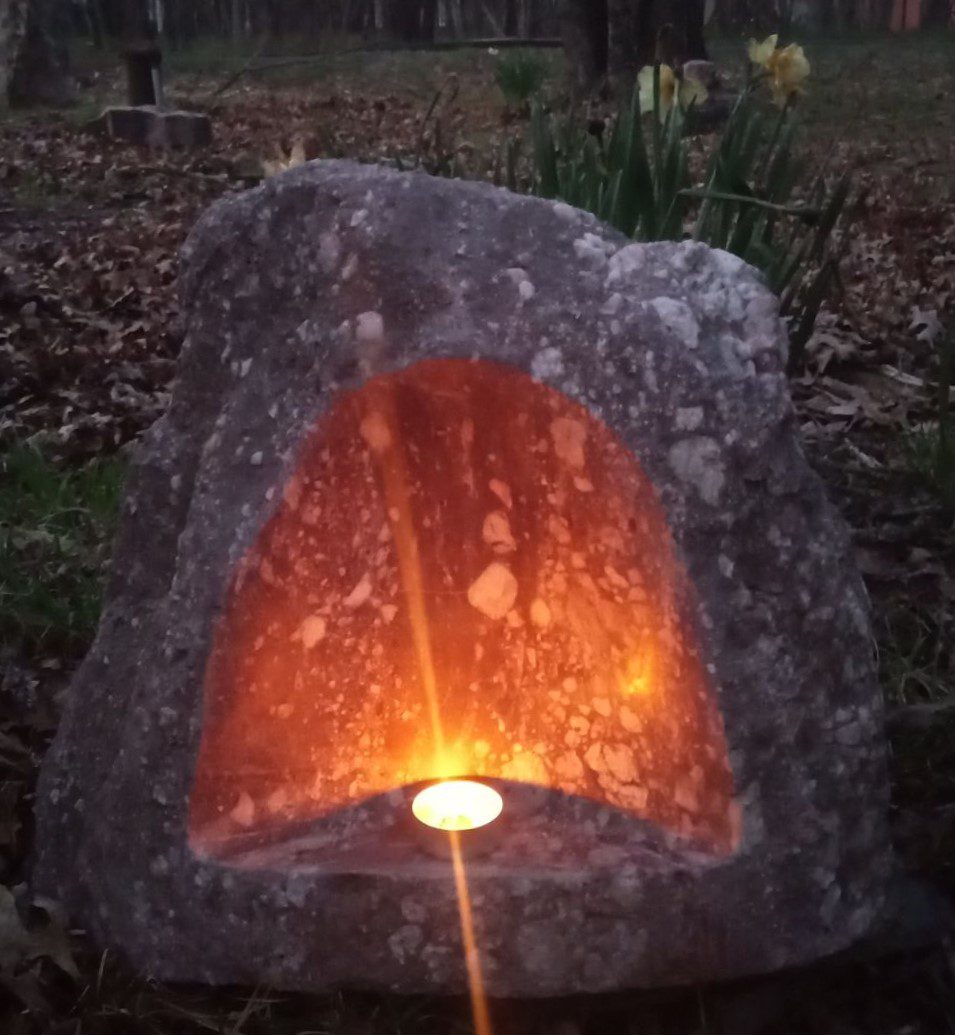
Holds a candle. Like with my benches and bird baths, my goal here is usually to present the stone with as much natural character preserved as possible–what is the minimal amount of work that I might do–to turn this piece into something functional, beautiful, and enduring?
Crop Circles
1. Proof that extra terrestrials and/or high dimensional entities are into nature art, too. 2. An example of land art, that famously was often attributed to “little green men” who wanted us to care about the environment, and also wanted to teach us about geometry.
Cave Painting
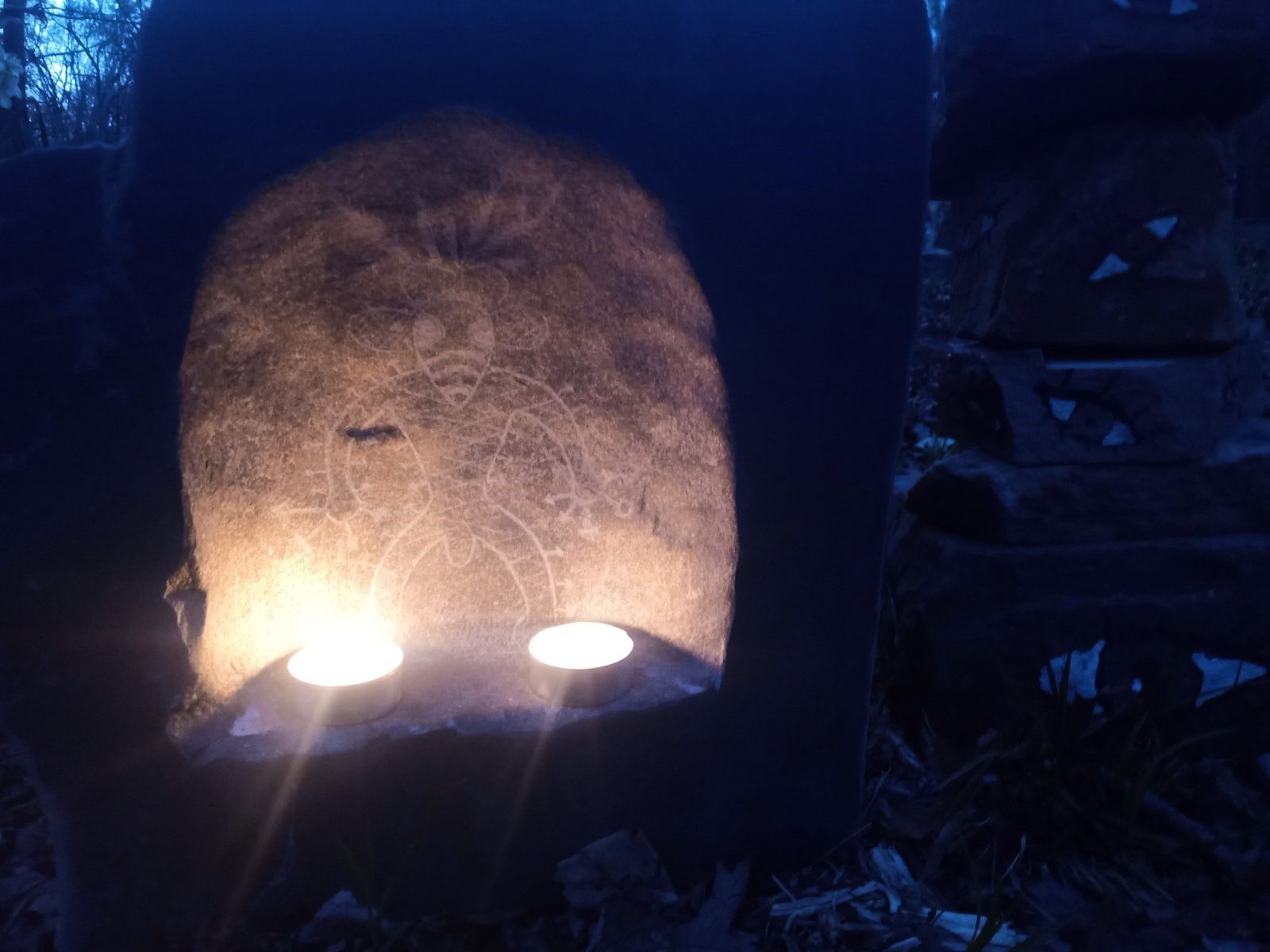
An old old form of rock art. Painted by flickering torchlight, in dim prehistoric times. Animal fat, saliva or honey, mixed with charcoal, or red earth clay. Ten thousand years ago. A hundred thousand years ago. We don’t know how long ago this may have started. We do know that early prehuman hominids made tools. Did they also make art? How far back do things go?
Cobble
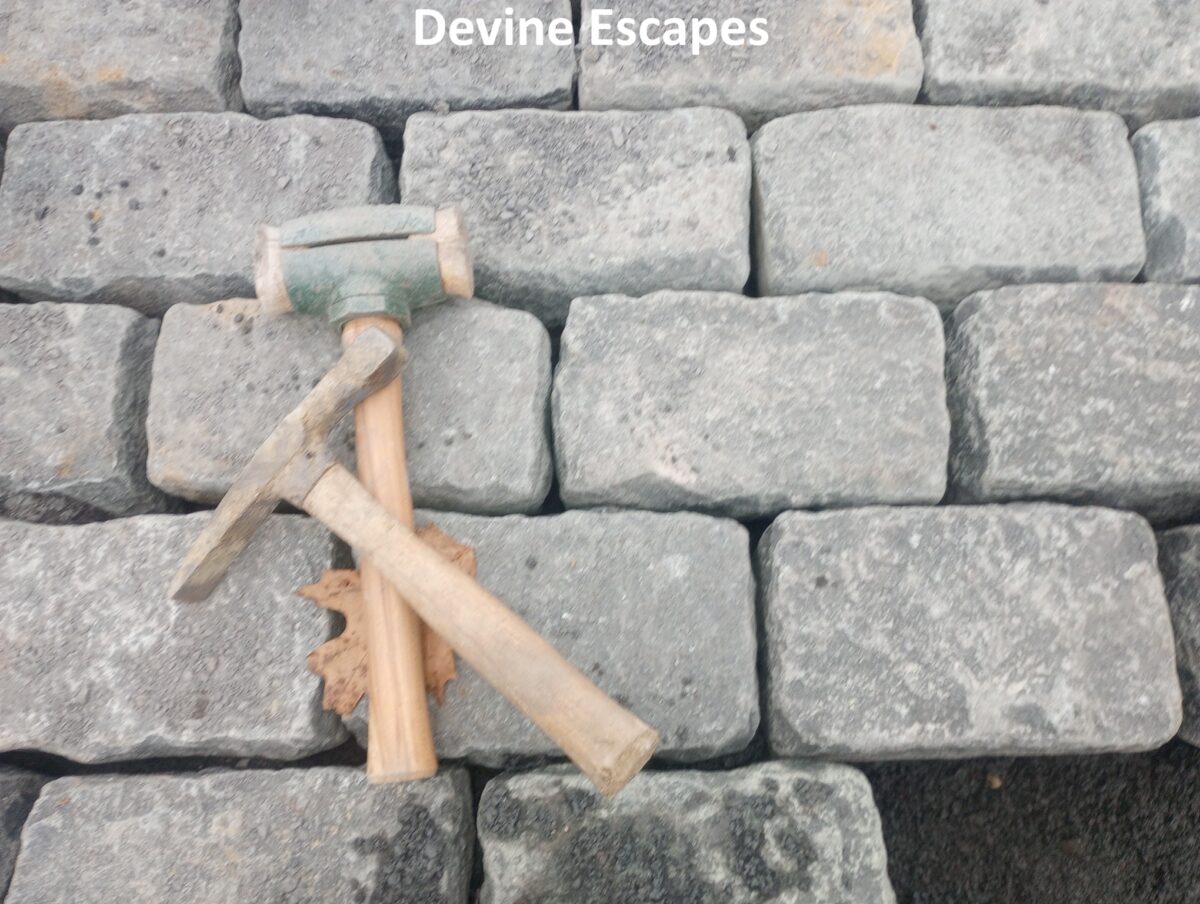
Paving stone who’s thickness is almost as great as its surface area. Like a brick, or a Belgium block.
Color Gradient
In land art, a color gradient is when stones, leaves, or other natural material is arranged in such a manner as to fade, from one color to another.
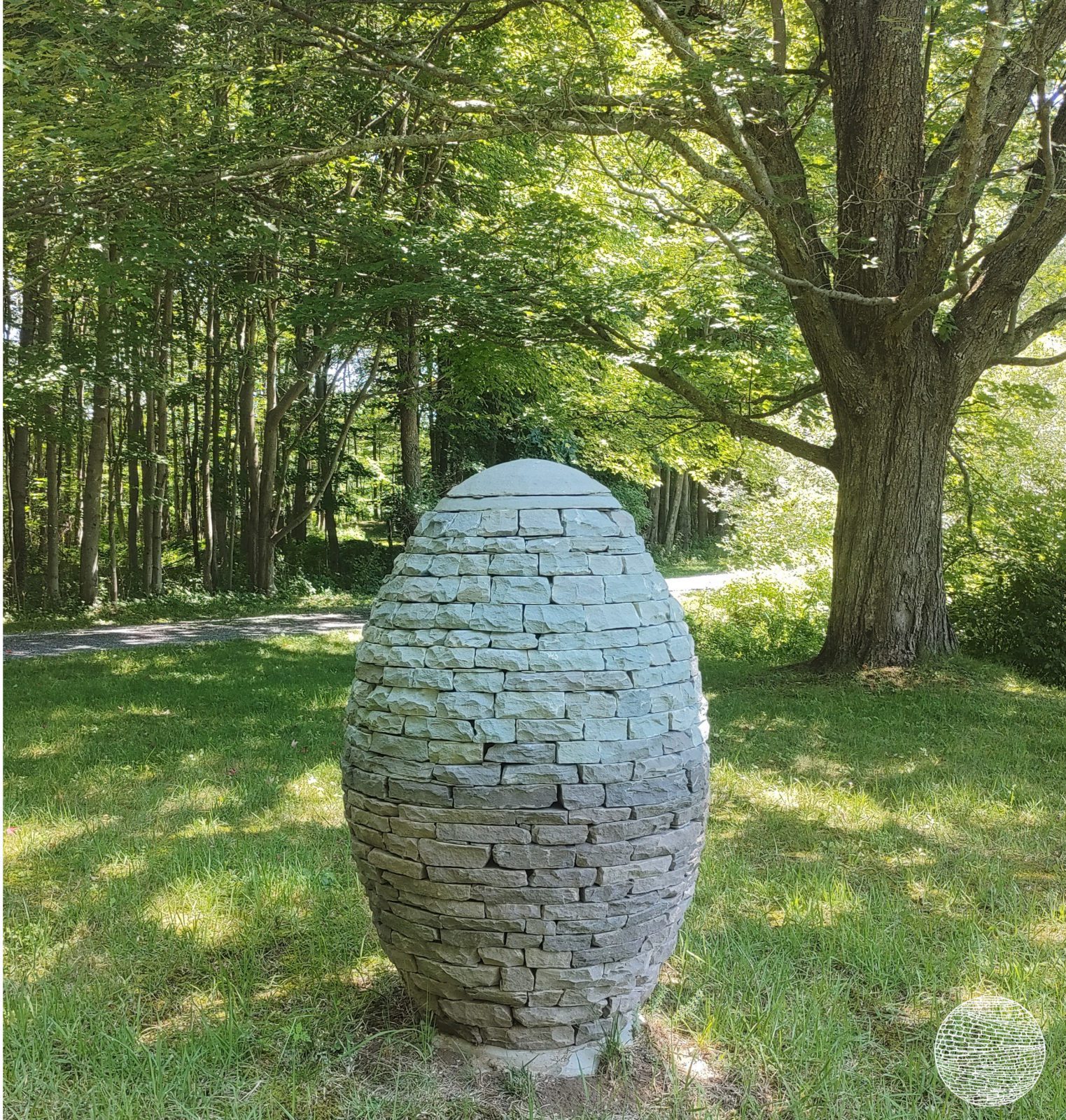
Dry Stone Sculpture Egg Cairn with color gradient from lilac to blue.
Decomposed Granite
1/4″ and/or smaller bits of granite with fines. Can be used as leveling agent and joint material for dry laid flagstones. And for leveling up fist courses of dry stone walls, etc. Used interchangeably with screenings aka quarry dust, aka 1/8″ minus or 1.4″ minus aka pathway fines aka manufactured sand
Devy Wovy
AKA Cairn House. A Cairn structure built with arched and/or lintel entryway, often looking somewhat like the remains or ruins of an ancient shrine of small temple. Called Devy after the present author and maker, and Wovy as the stones are woven together, often hastily, and more loosely than say a Lithadelic Sculpture.
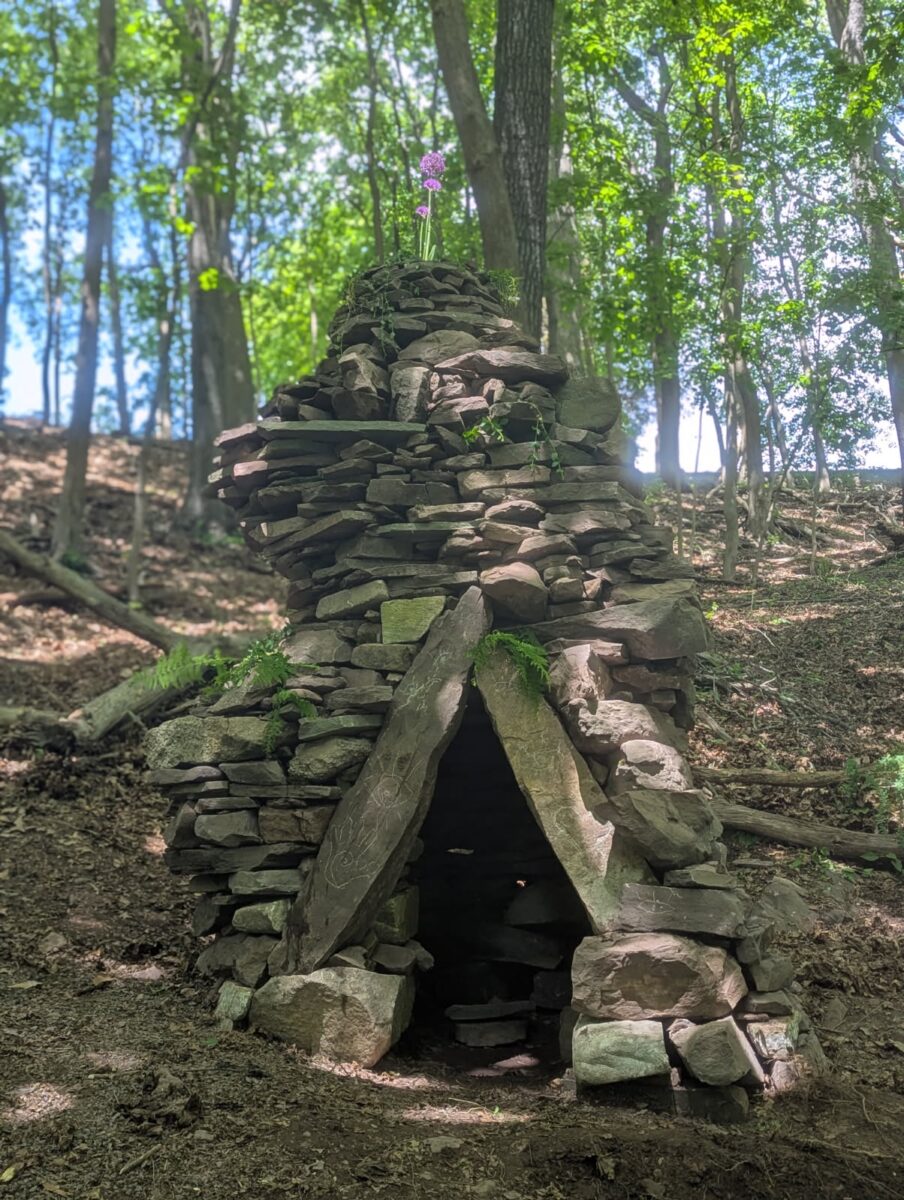
Devy Wovy made as a group workshop project
Dolmen
A simple rock shelter, consisting of 2 or 3 upright stones, and one stone slab serving as the roof.
Donations
DONATIONS Help keep artists alive, and creating. You can also help support Devine Escapes by commissioning an artwork, donating monies, or setting up a phone consultation where I teach you how to build your own patio, wall or cairn
Dots
Dots are like circles, but smaller. A sphere, manifested on a lower dimensional plane. Dot painting, has been a bit of a contemporary trend but then, it’s not exactly a new thing, as demonstrated in cave paintings, petroglyphs and aboriginal art.
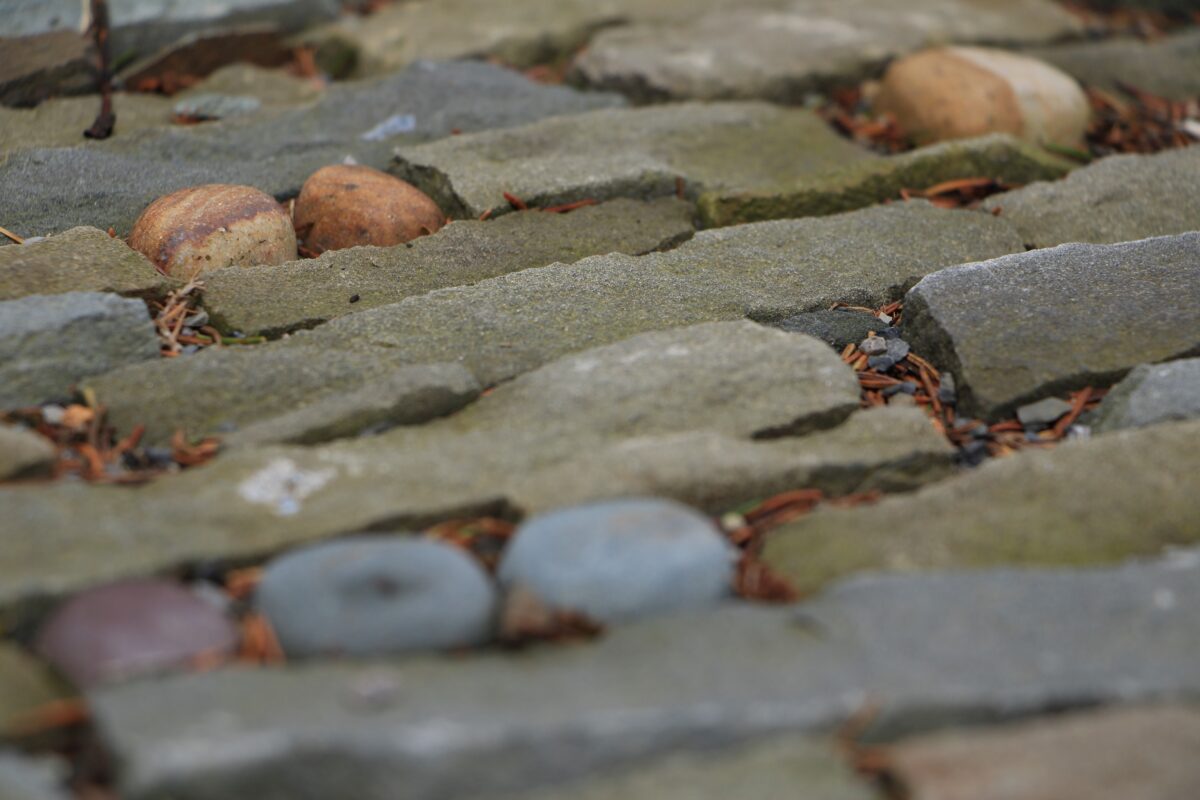
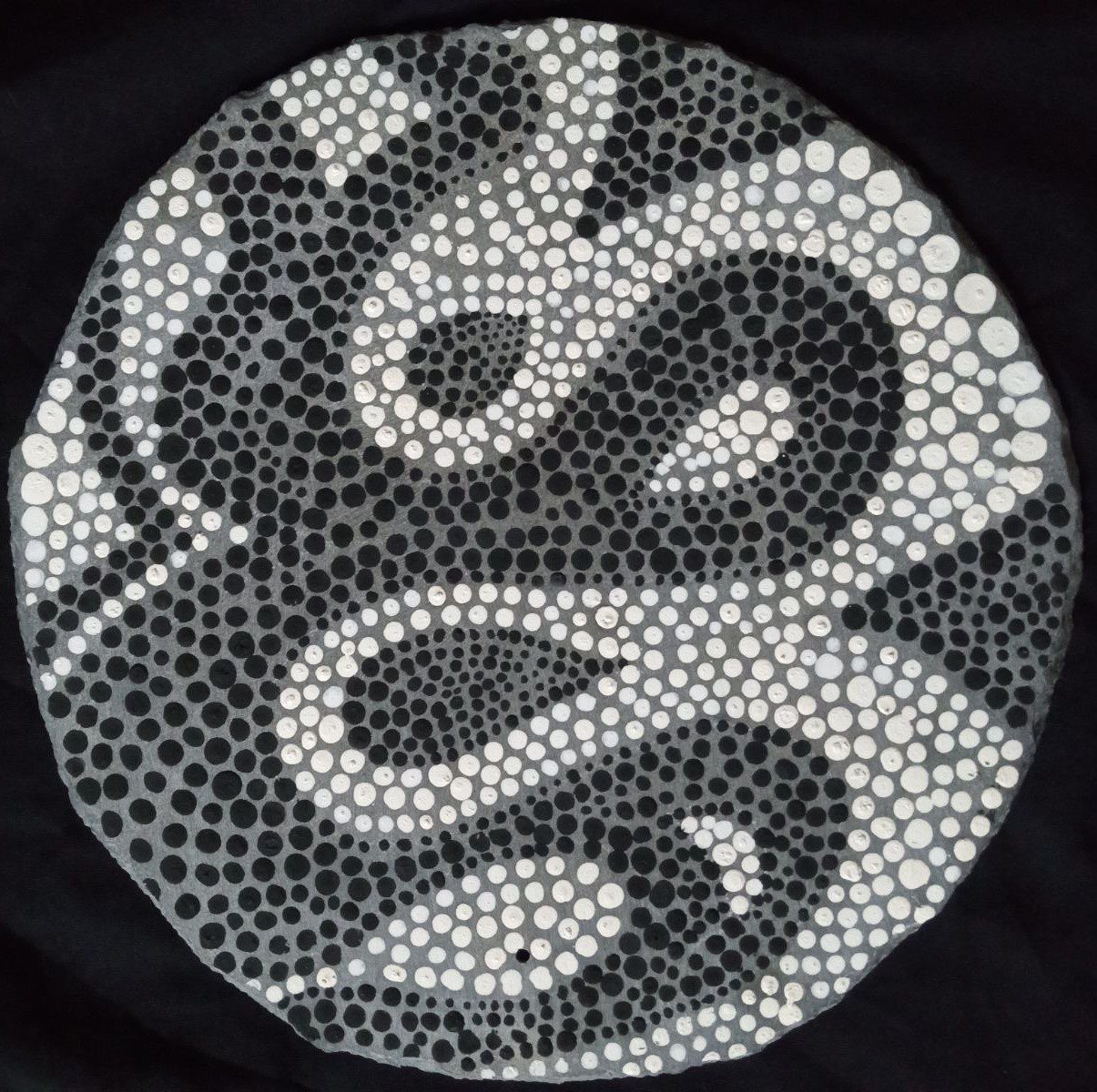
Available. Abstract dot painting, on 10″ slate circle.
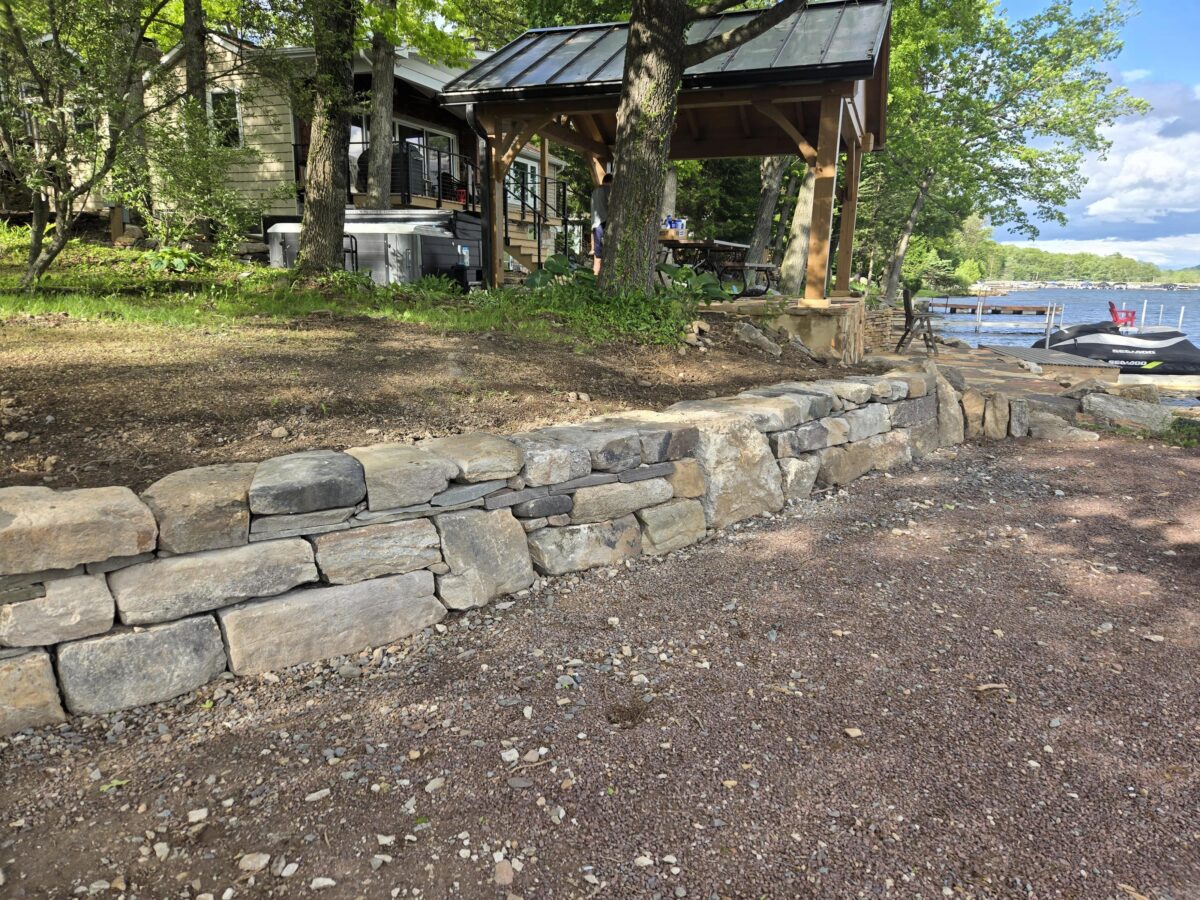
Dry Stone Wall
Stones arranged, without a mortar material, into a wall form. These come in many shapes, forms, regional and vernacular styles and forms. We’ve written one article, describing how we build our own dry stone walls.
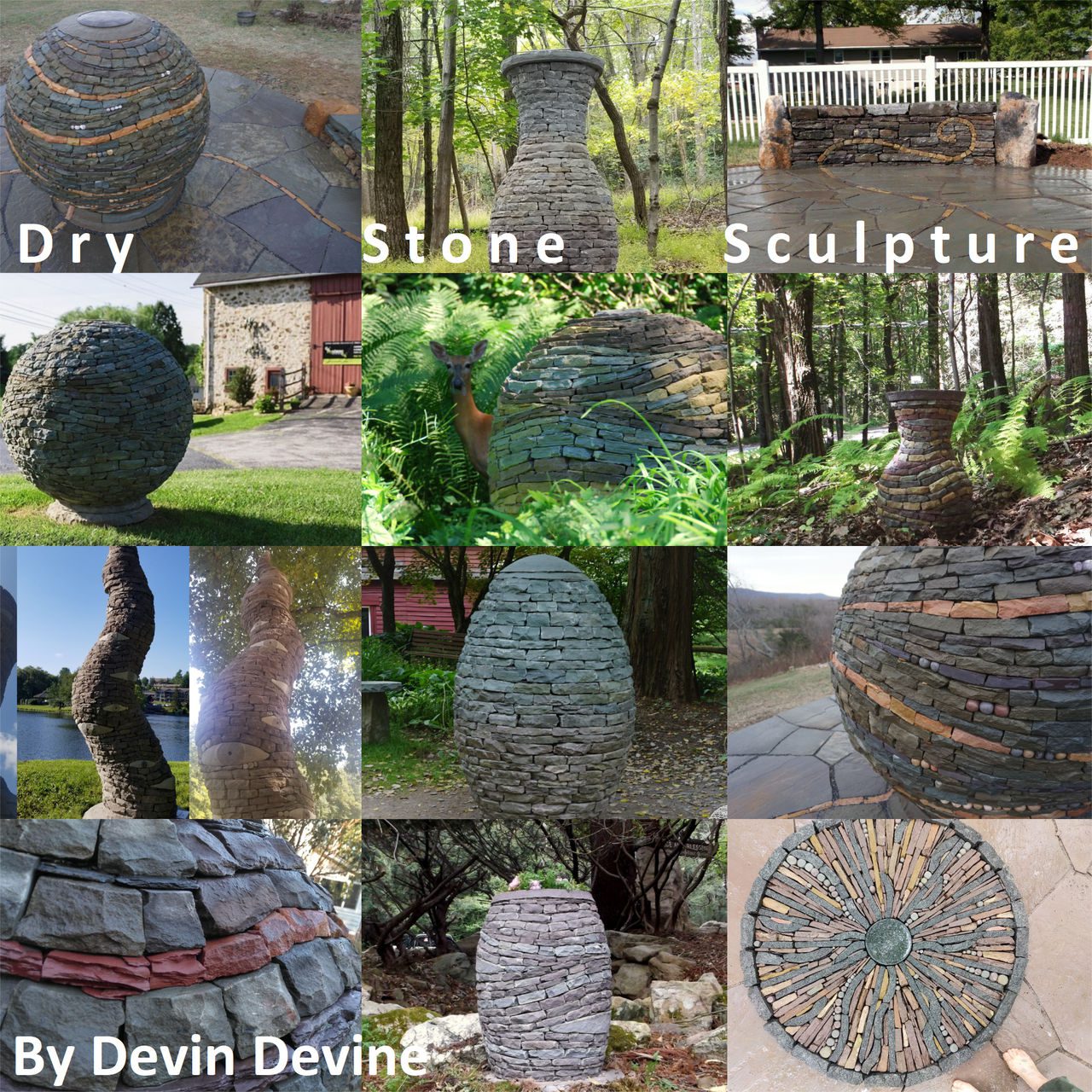
Dry Stone Sculpture
An example of natural material asemblage`. A form of additive sculpture, which uses the methods and materials of dry stone walling, to create works of art. Like a cairn, but usually more refined. If you use hammers, saws, torches, a vast array of chisels and/or grinders on your cairn–well, then you’ve probably strayed pretty far from traditional rock cairn building…and actually, most of those tools don’t have much connection to the history of walling, either. But that’s the definition we’re going with, for our lexicon, for dry stone sculpture. Basically any cairn that’s too elaborate and/or refined, to be called a cairn.
Earth Work
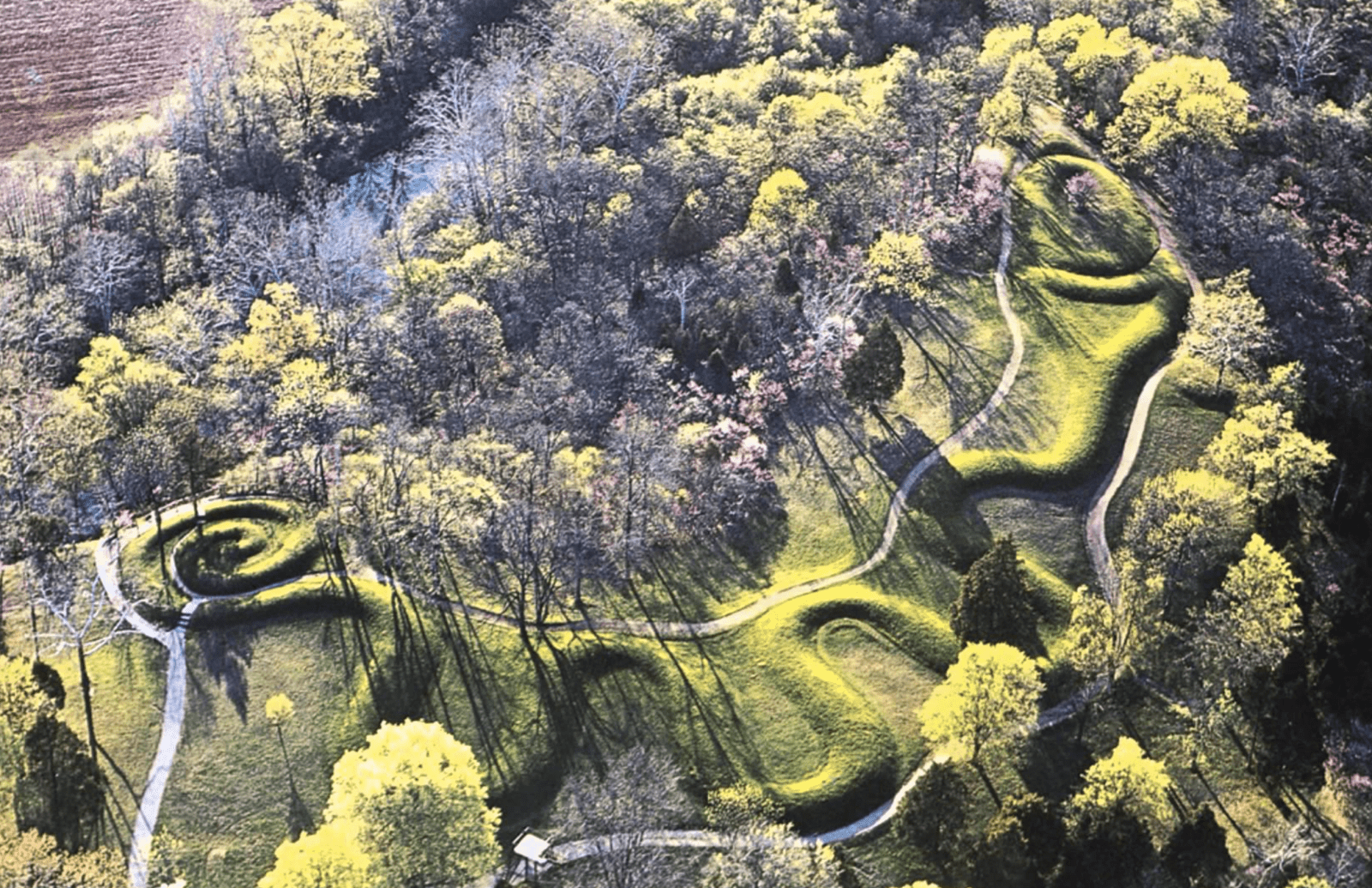
Soil itself, may be used as a sculptural medium. The Serpent Mound, being one large scale, and ancient example.
Egg Tempera
An ancient type of paint making, which can be used today still, to create artists quality fine art paints.
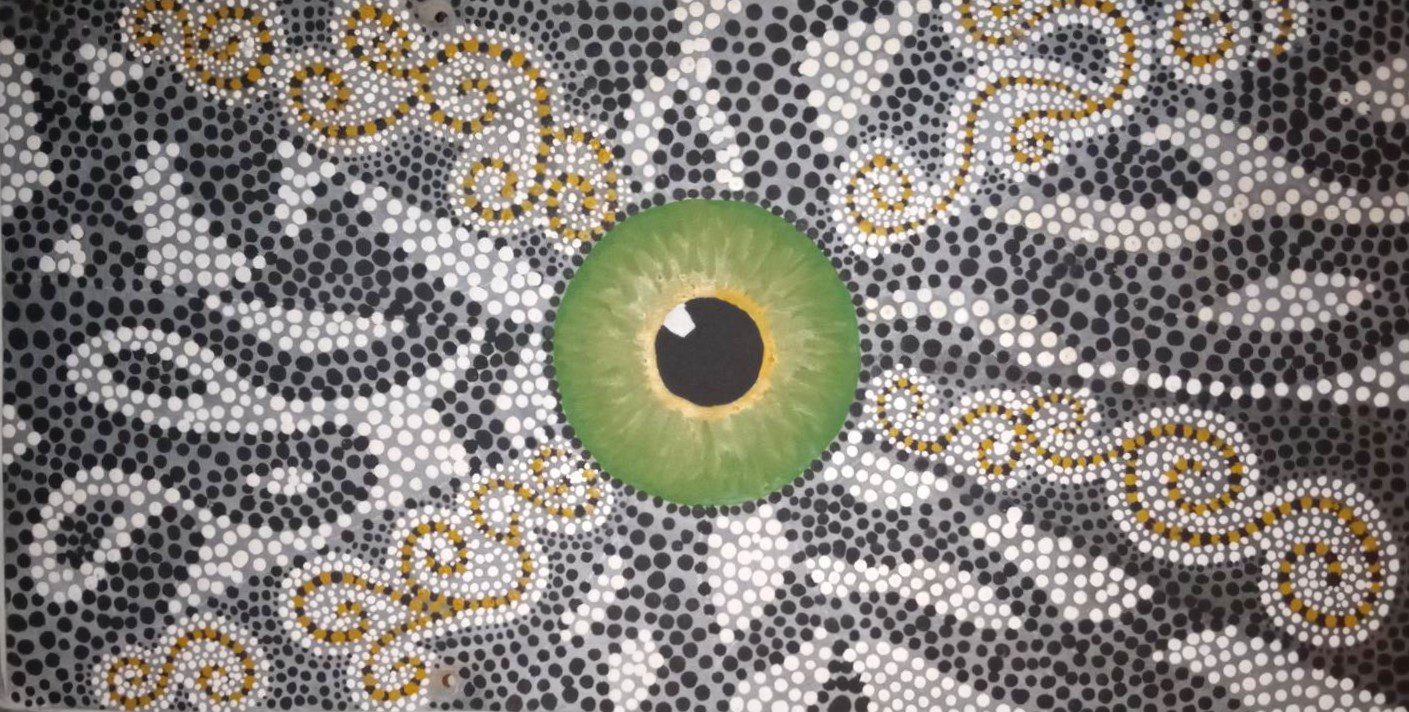
Available. 12″ x 14″ abstract dot art dot mandala. Email devin@devineescapes for pricing. Collaboration by Devine Escapes founder, Devin Devine, and Devine Escapes Artist Eva Koch.
Flagstone
A paving stone who’s surface area is greater than its thickness. A slab of stone, thick, with much surface area. A flagstone that is only one foot of surface area, while being only an inch and a half thick–might not have enough surface area, to be stable. If it were much thicker–it could be a cobble. More surface area–it could be a flag. In either case, to do good stone paving, your materials should be sorted, and used appropriately. Every stone has a place and function, where it will perform and succeed. No such thing as a bad stone, just a good stone then, in the wrong place.
I teach this stuff, to homeowners and contractors, for an hourly rate.
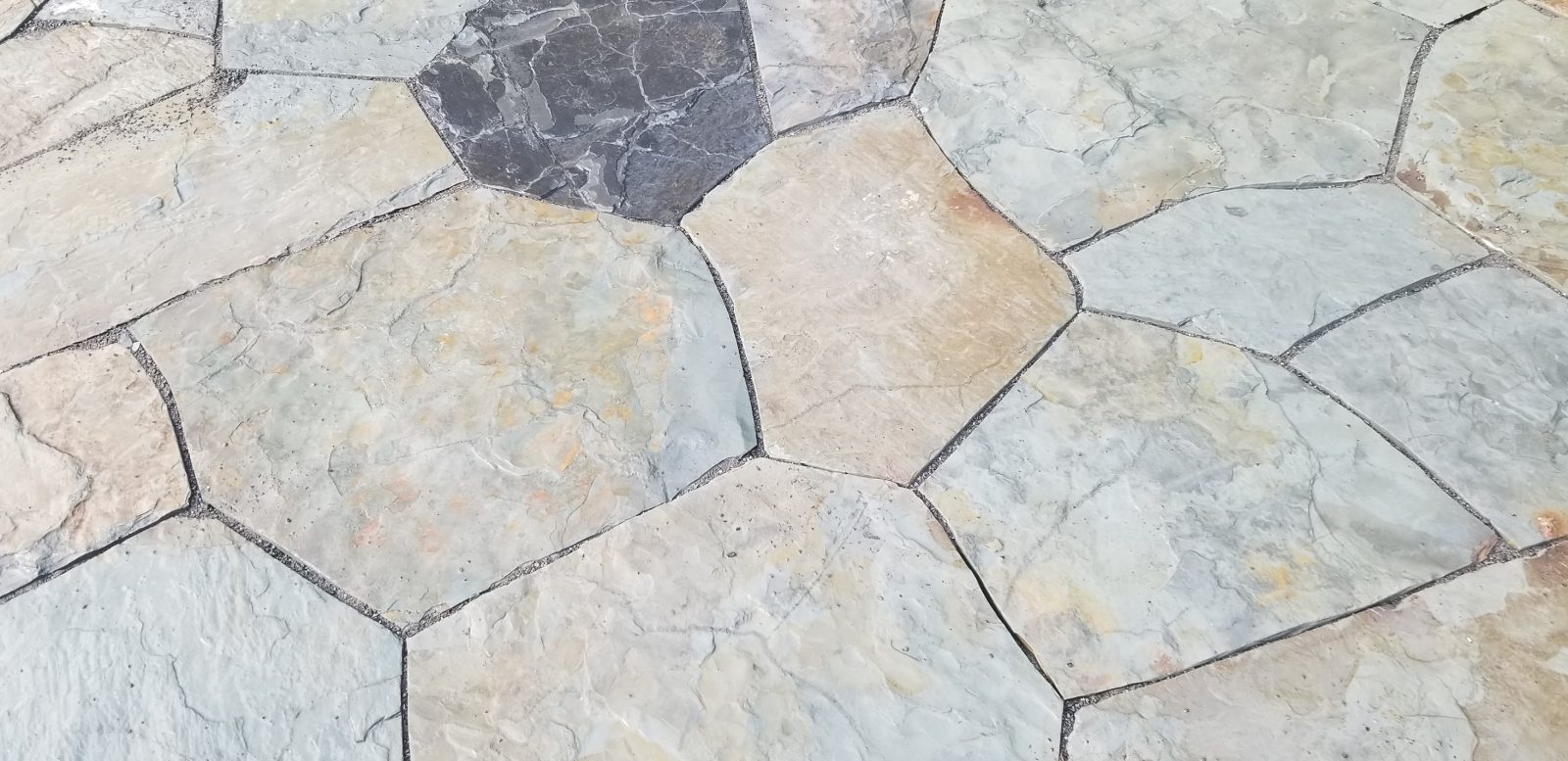
Detail of a patio I built with Argilite, in Sebastopol CA 2019. I can be convinced to travel for work.
Fountain
They ask me, often, how come you don’t build your dry stone sculptures as fountains? Well, because they are interesting enough to look at already, without any flowing water. But okay–every once in awhile, I can be convinced into making a fountain.
Gravity
What comes up must come down. But if you follow the rules set forth by gravity, then you may lift an object up and hold it aloft, for a span of time. So many of the terms set forth in this lexicon, are just effects of, or rules set by Gravity.
The Serpent Mound for example, has a shape that must have been partially determined by the Angle of Repose. That’s Gravity. Pyramids are built the way they are because of this effect. Dry stone walls are built with a batter for this same reason.
Geoglyph
A large design made on the ground usually from rock or other mineral substance. Most famous of these would be the Nazca Lines, which were only visible to the gods, aliens, and possibly witches–until the invention of airplanes.
Hearting
Hearting is made up of smaller rubble, stones too small to be used as a stable face-stone. Chunks of stone about the size of your fist and gold-back sized pieces of stone…..you don’t want to fill your wall with little gravel sized bits. Don’t shovel your hearting in to place. Fit them stones nicely–this is the heart of your wall.
Hill Figure
A type of geoglyph that is carved into the side of a hill, so as to be visible from a distance. All examples that we know of are in England. Please, let us know of any others, in the comments.
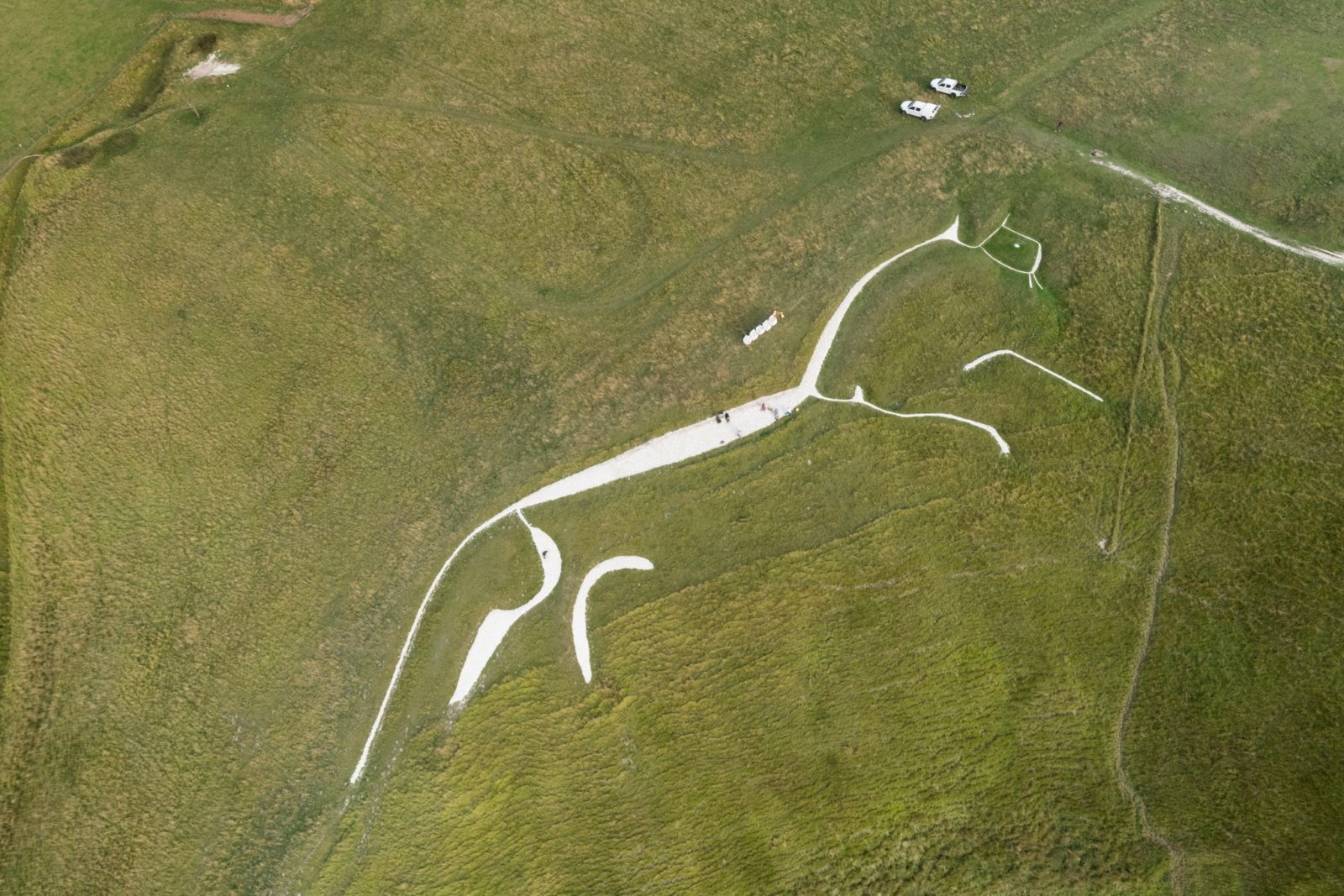
Aerial view of volunteers re-chalking the bronze-age horse figure at White Horse Hill, Oxfordshire.
The white Horse of Uffington is a well-known example. 360 feet long, this prehistoric hill figure consists of trenches filled with white chalk. It has apparently been maintained for over 3,000 years, though I’m not old enough to confirm.
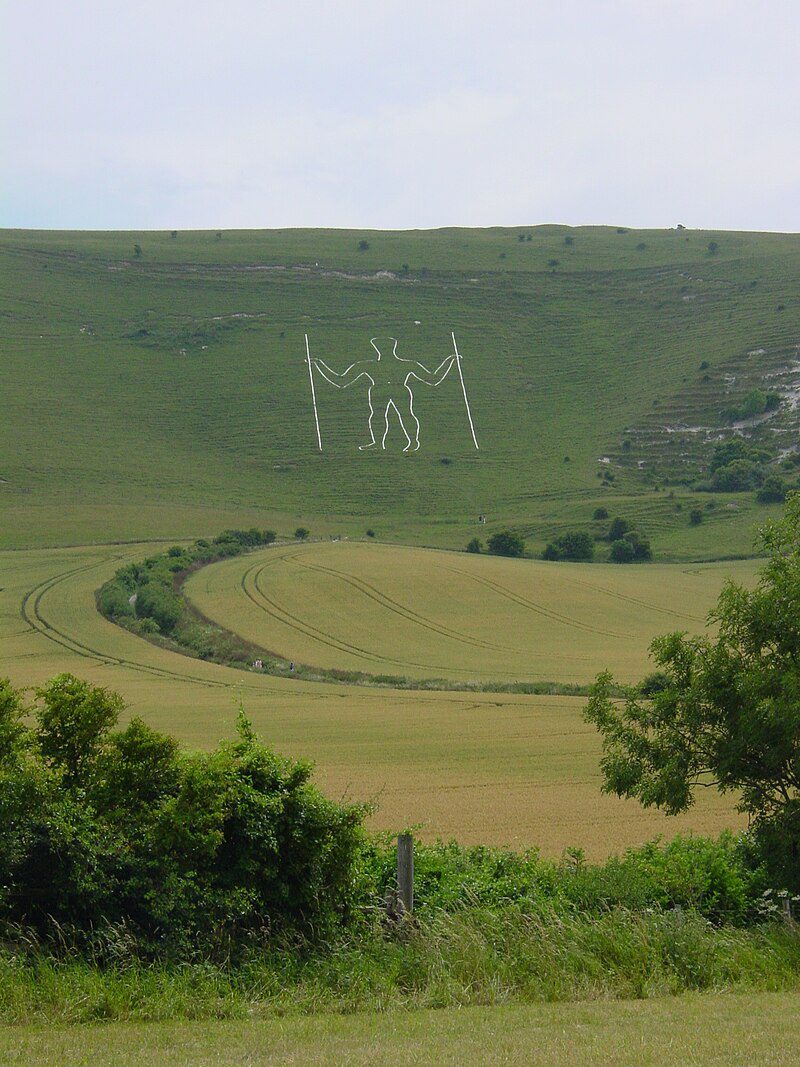
The Long Man of Wilmington.
Inukshuk
A simple humanoid representation, a stick figure made from 4 stones or more. These are an Inuit tradition and the word Inukshuk or Inuksuk, comes from the northern peoples. Apparently the word means, “like a person”, or imitation of a person. This amuses me because I’ve built so many cairns over the years, where I wasn’t trying to make it human-like–yet, when I’m working I catch the piece from the corner of my eye it sort of startles me, thinking there’s a human standing there!
Inlay
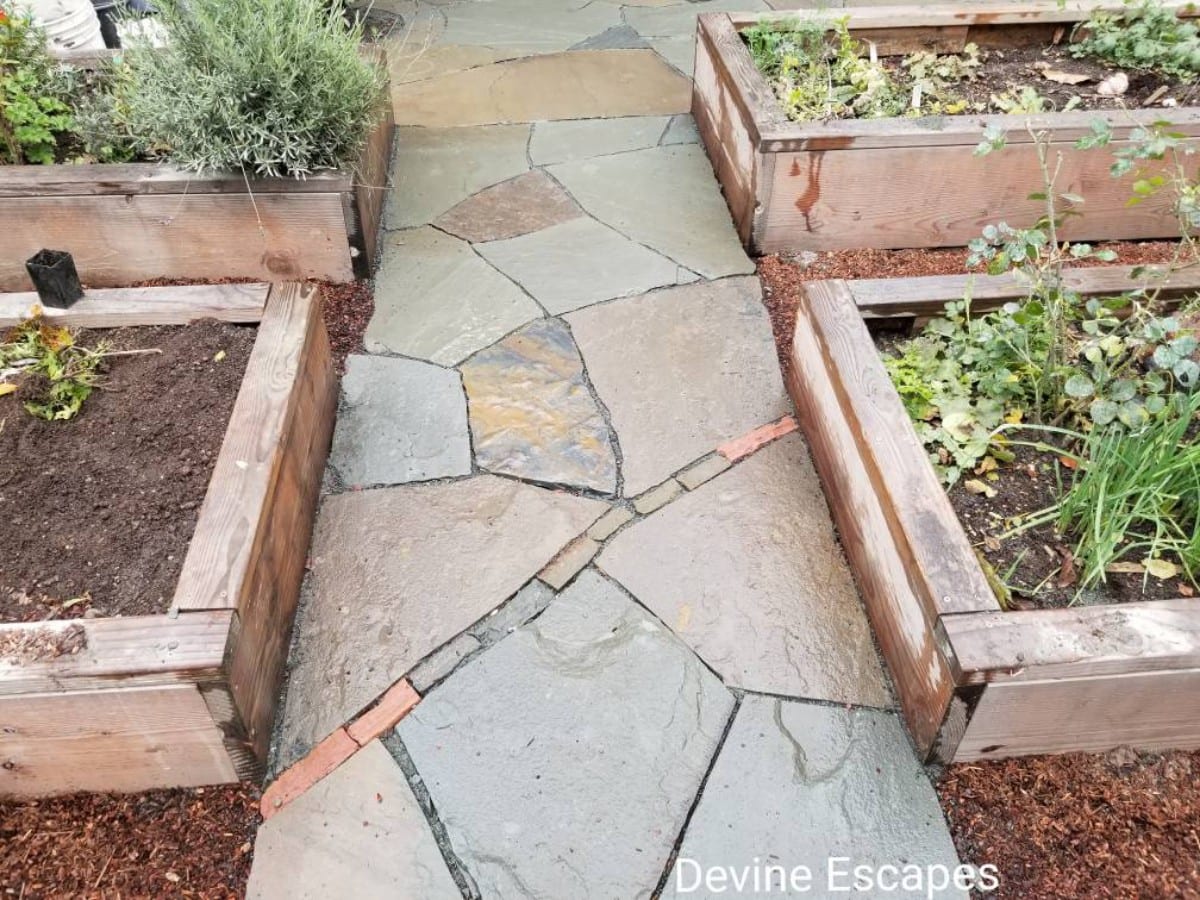
When one form moves through another. A yellow stone for example, could be used as an inlaid pattern moving through a gray stone patio.
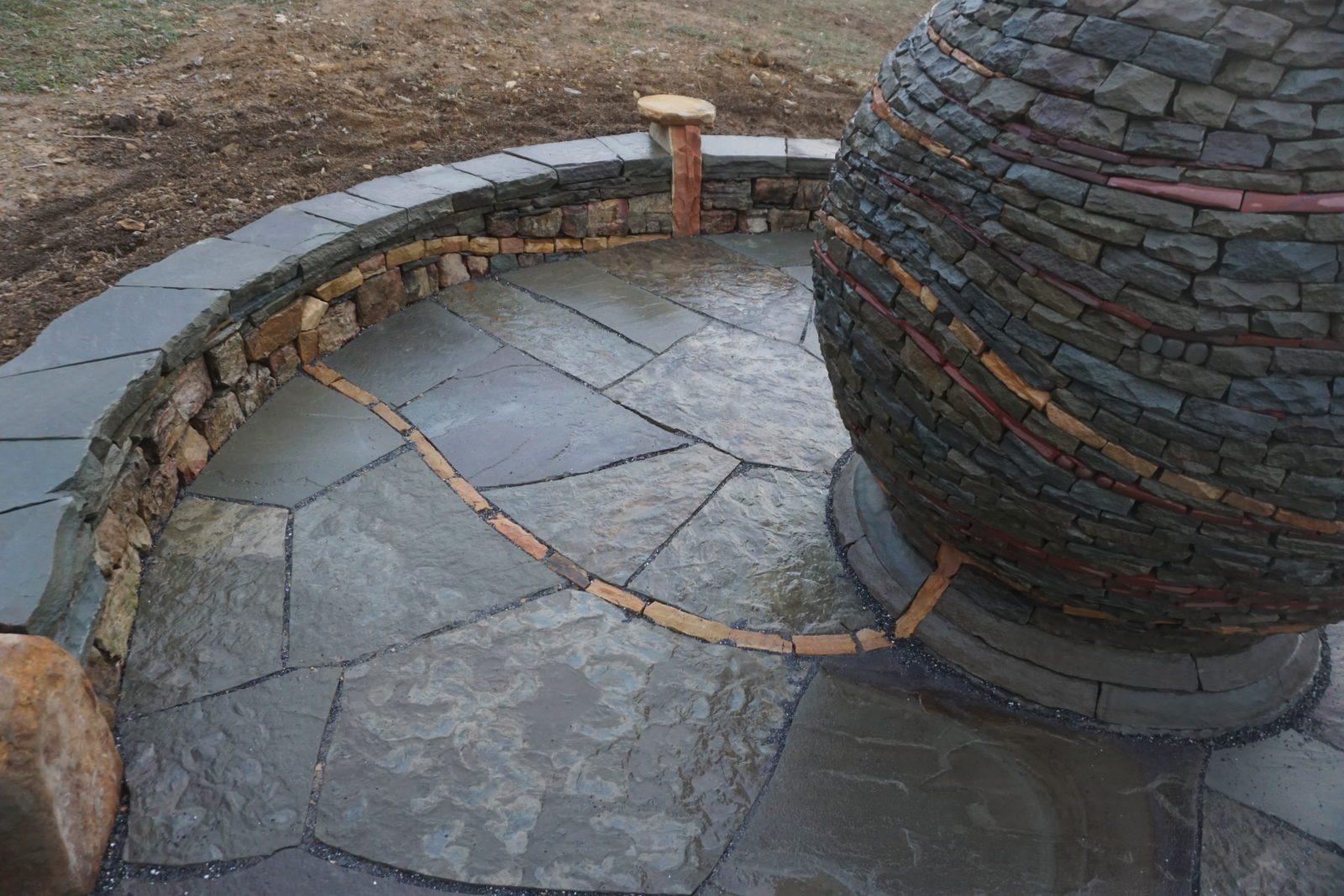
The sphere is 5′ tall, is built dry, and is integrated into the wall and patio, via a shared inlay moving through all 3.
Lithadelic / Lithadelia
A distinct style of flowing stone masonry, where the individual stones are seen to flow, like the movement of water, or like the movements of a school of fish, through that water. Lithadelia is an example of artistic dry stone masonry, although technically, mortar could be used. The terminology is derived from 1960’s culture, borrowed from another term which meant “mind manifesting”. Lithadelic then means manifested from stone and Lithadelia is stone manifesting– or perhaps mind-manifesting works, wrought from living stone on a living planet. By a living man.
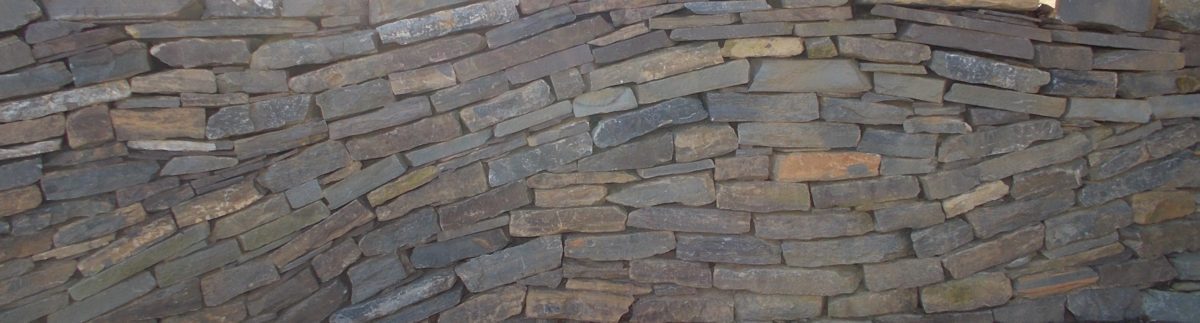
Lithadelic dry stone wall, Philadelphia 2012
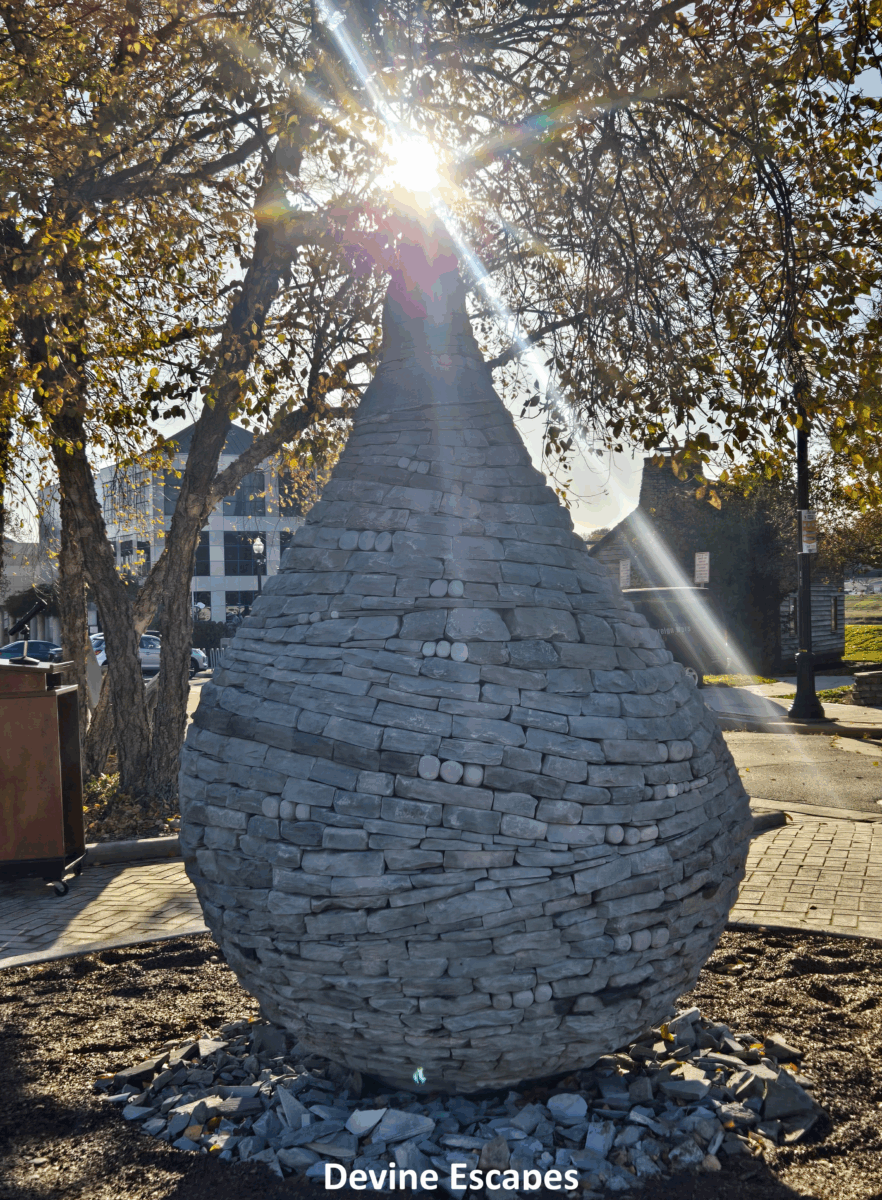
Lithadelic Tear, 8′ tall sculpture in Hamilton Ohio 2026
Nazca Lines
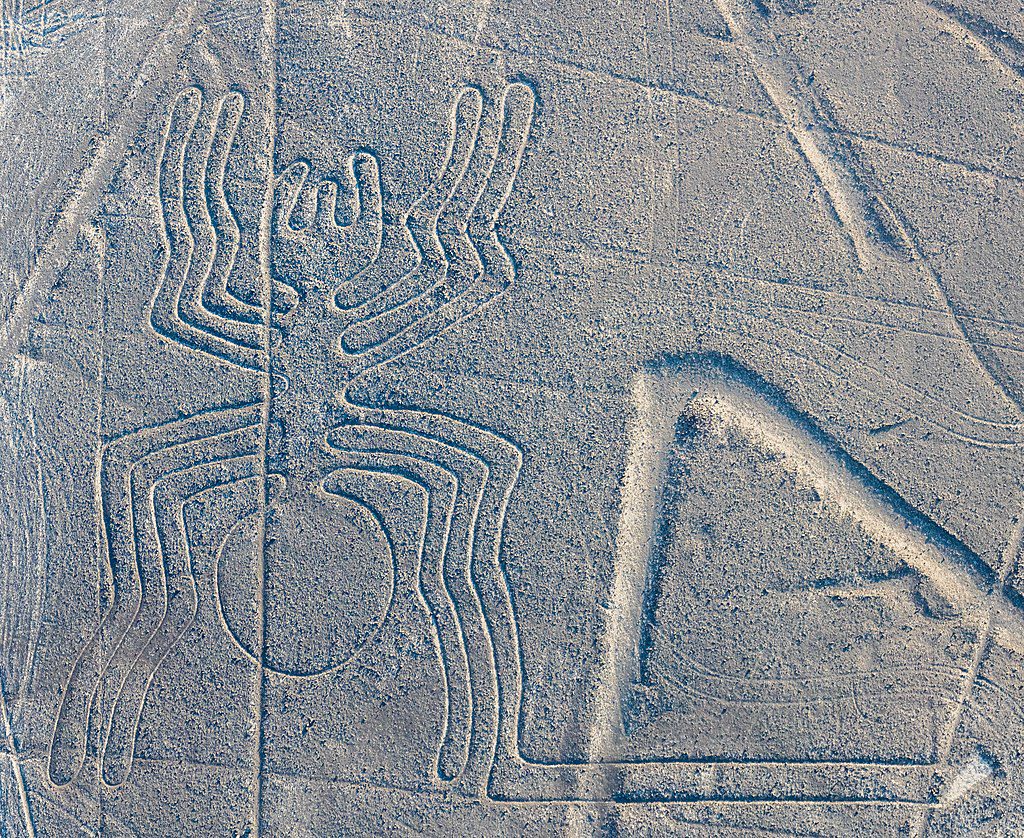
Another ancient Earth Work. Stones and soil were used to create long straight lines, geometric forms, as well as anthropomorphic and animal representations, in the Nazca Desert in Southern Peru. These large scale geoglyphs are only fully visible, from the sky.
Noodle
A type of cairn structure and/or dry stone sculpture, in which the stones are arranged in the form of a tower that tapers, and waves from side to side. The movement is like unto that of a tentacle.
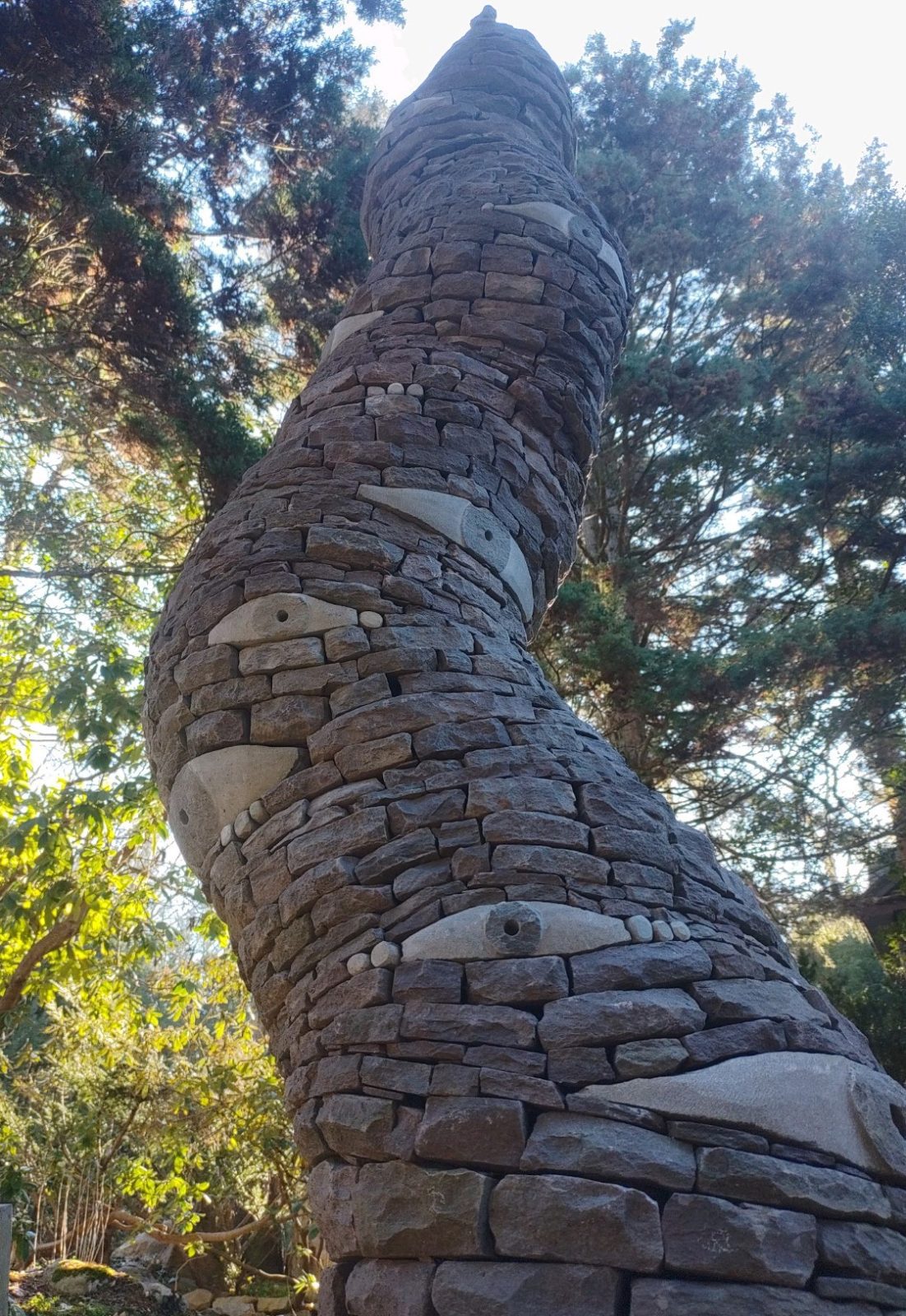
Squiggly Noodle, Tentacle with eyes sculpture
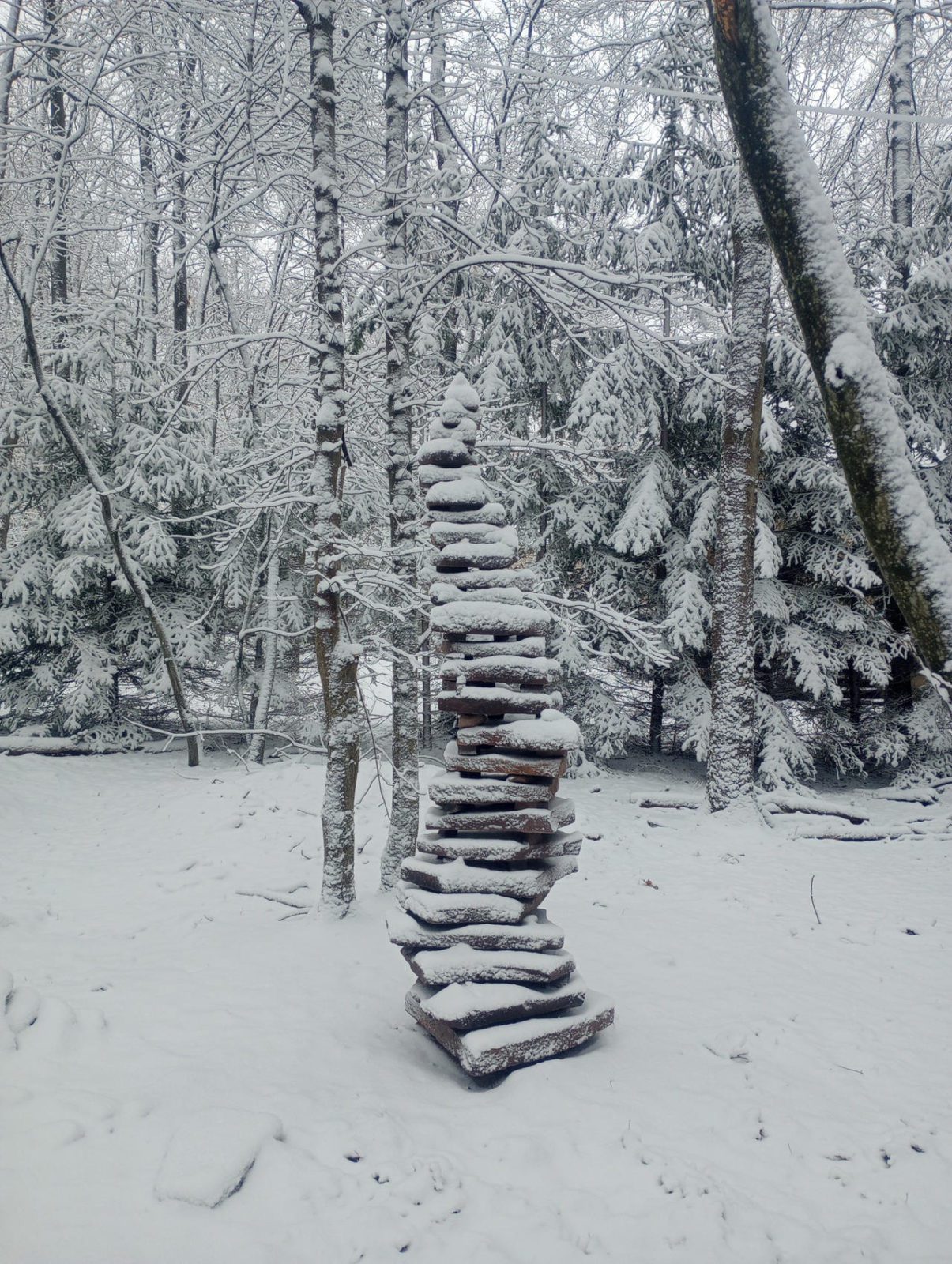
Pagoda Style Noodle
Mandala
A geometrical drawing, usually starting with a circle. According to wiki “In various spiritual traditions, mandalas may be employed for focusing attention of practitioners and adepts, as a spiritual guidance tool, for establishing a sacred space and as an aid to meditation and trance induction”. But then again, we could say most of that–about most forms of art. Mandala is a useful tool, for finding one’s center. Ah, now you see why they are drawn circular. Mandala has been called “a model of the Universe” and a “portrait of the artist’s mind”.
We’ve had Buddhist friends show up with colored sand, and taken part in the creation of temporary art and meditation with them.
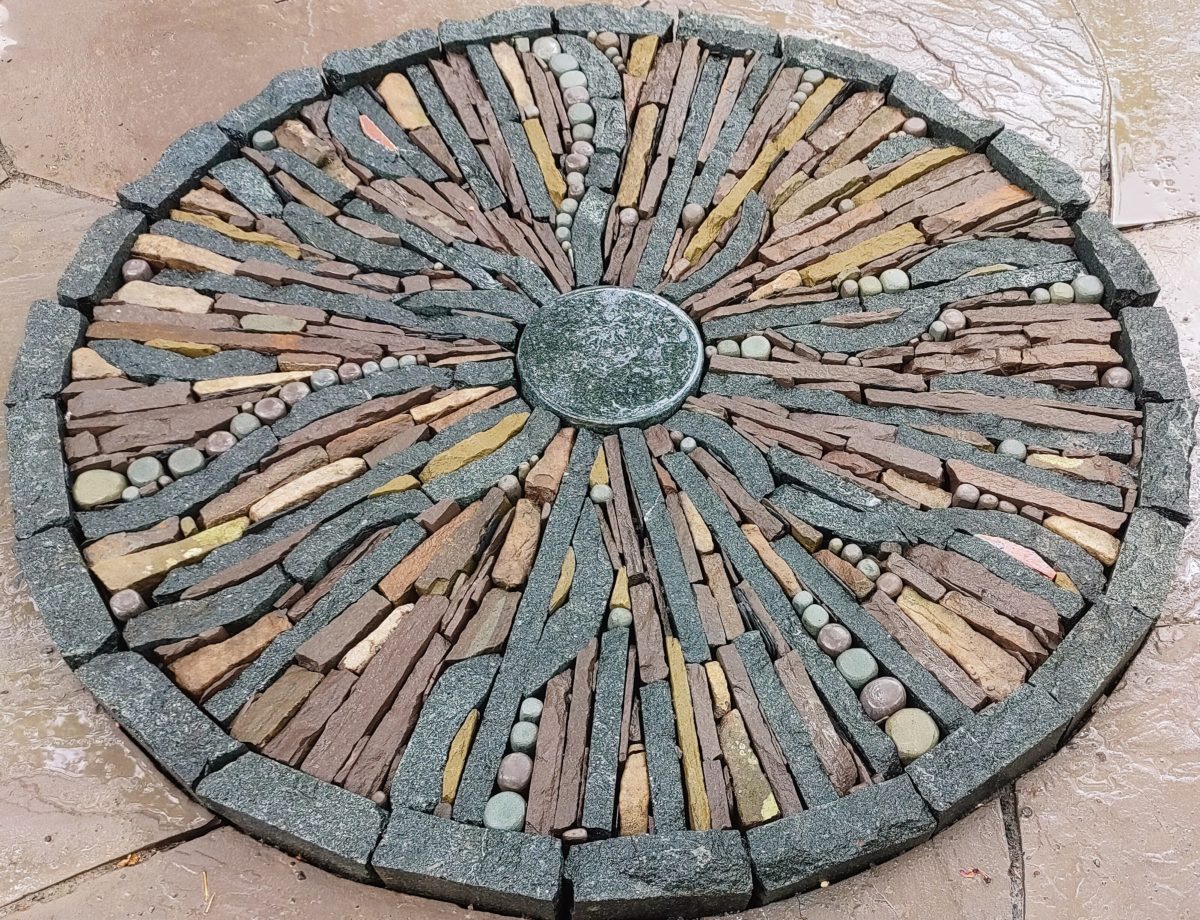
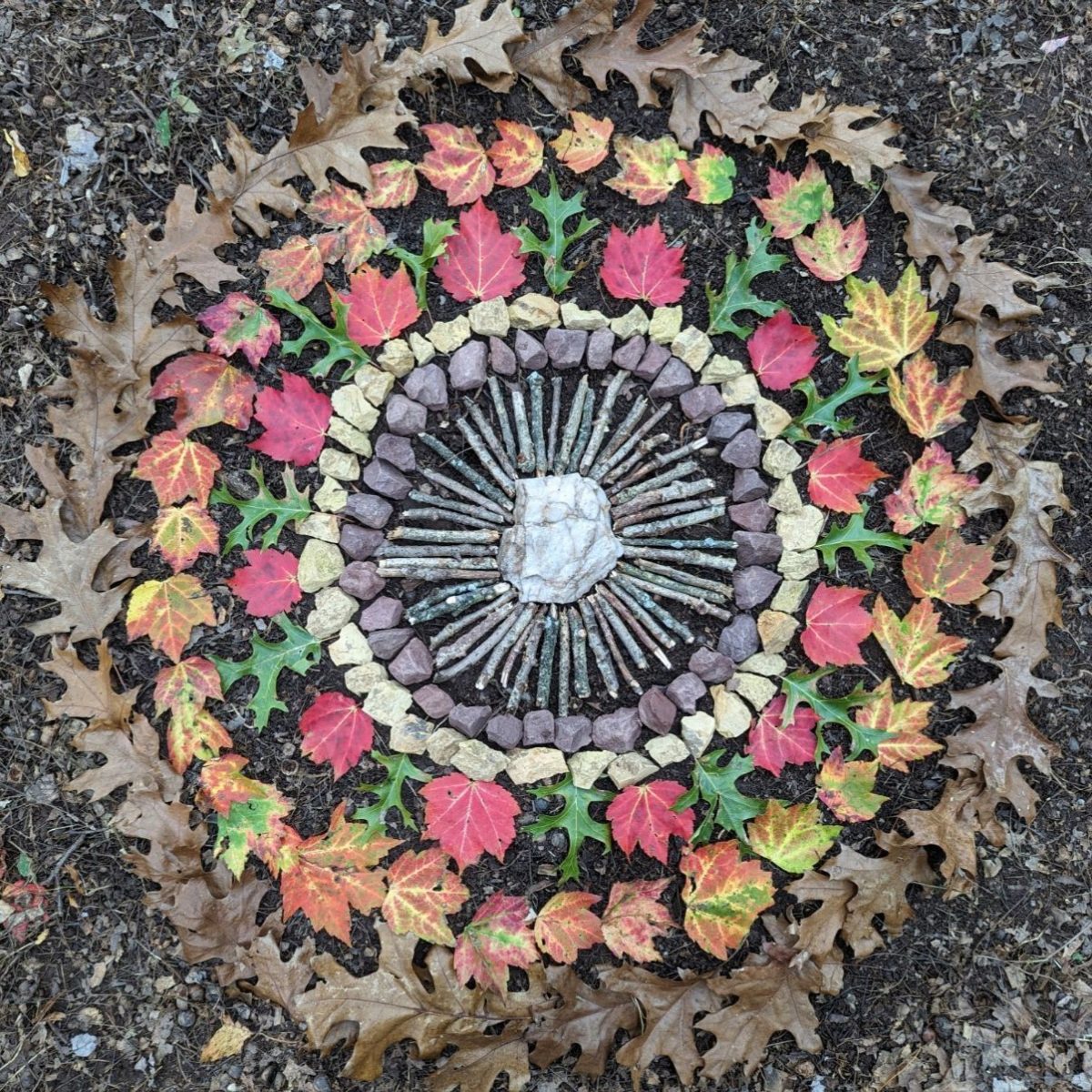
In land art such mandalas are created from whatever is on hand. Materials such as twigs, rocks, shells, pine cones. Gather some stuff, and make something mandala-like with that stuff. What’s stopping you?
Mortise and Tenon (learn this vernacular, it will serve you well)
A means of joining two members, by carving the end of one member into a peg so that it fits into a hole that you’ve carved into the other member. Glue and/or nails are unnecessary. We’ve seen many a piece of so called rustic furniture that could be much improved, if there weren’t bolts and screws visible.
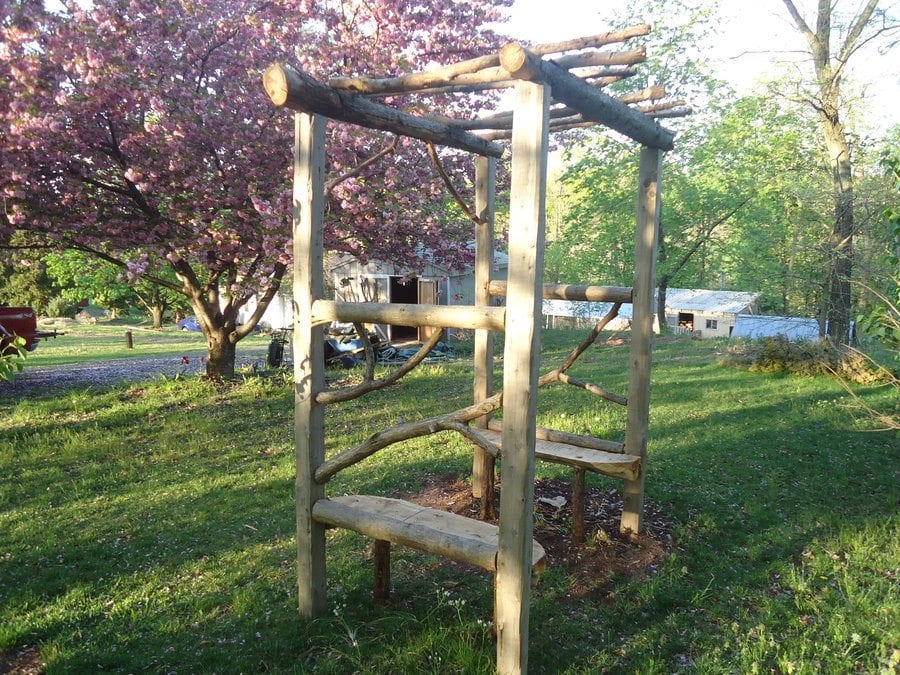
Log Arbor, hand made from cedar logs and branches
Mosaic
When little bits of ceramic, stone, mirror or what-have-you, are used to describe a picture. Usually done with grout or a cement binder of some sort, I have been developing my dry stone mosaic technique since 2009, which usually involves laying thin stones upright, as cobbles, within dry laid flagging.
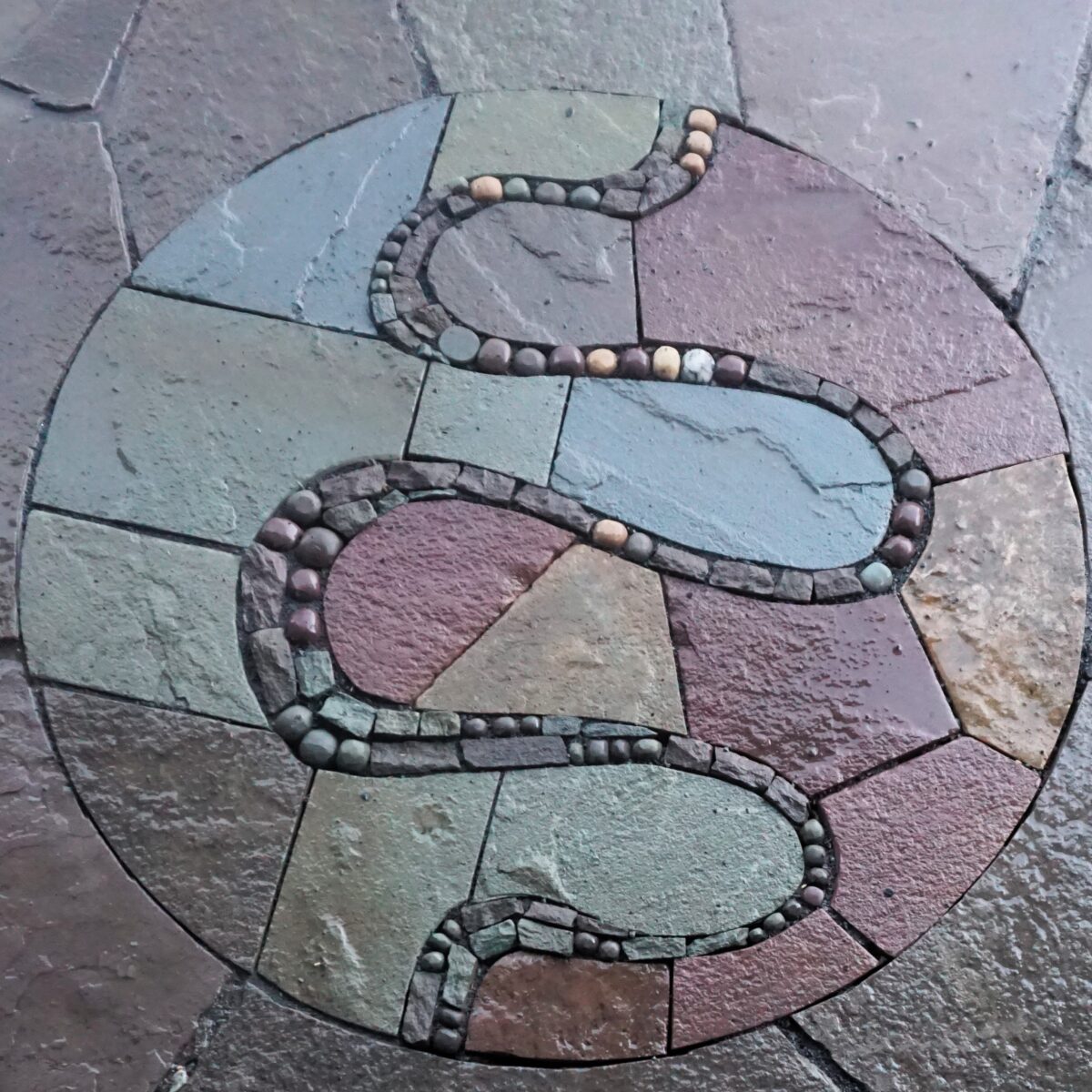
Patio with mosaic elements
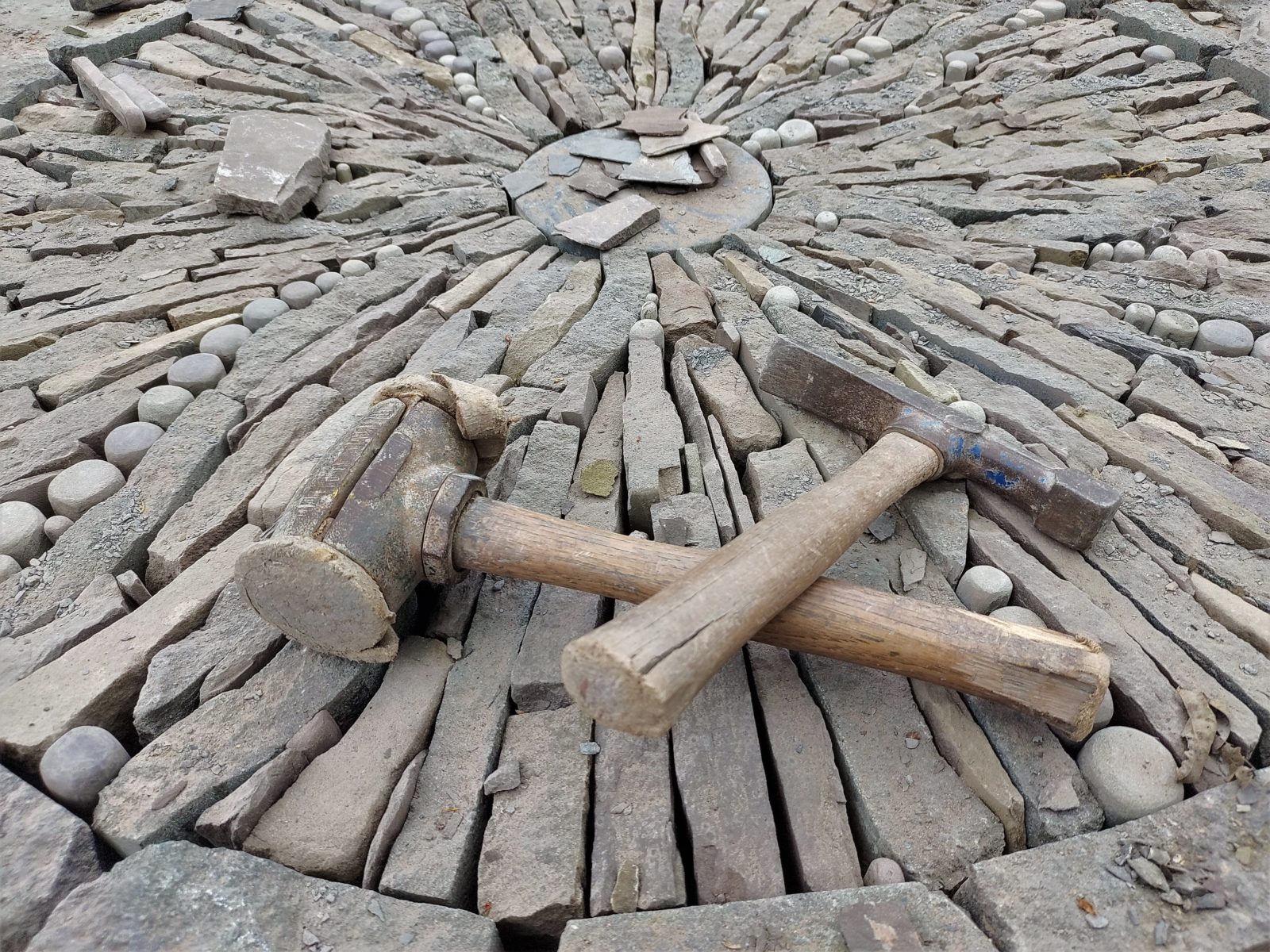
Dry stone mosaic accomplished, here, without any cement or mortar of any kind.
Pagoda
A style of Cairn–not of rock balance. This is because it is structural, in form. Flat slabs of stone are stacked with 3 balancer rocks, per slab.
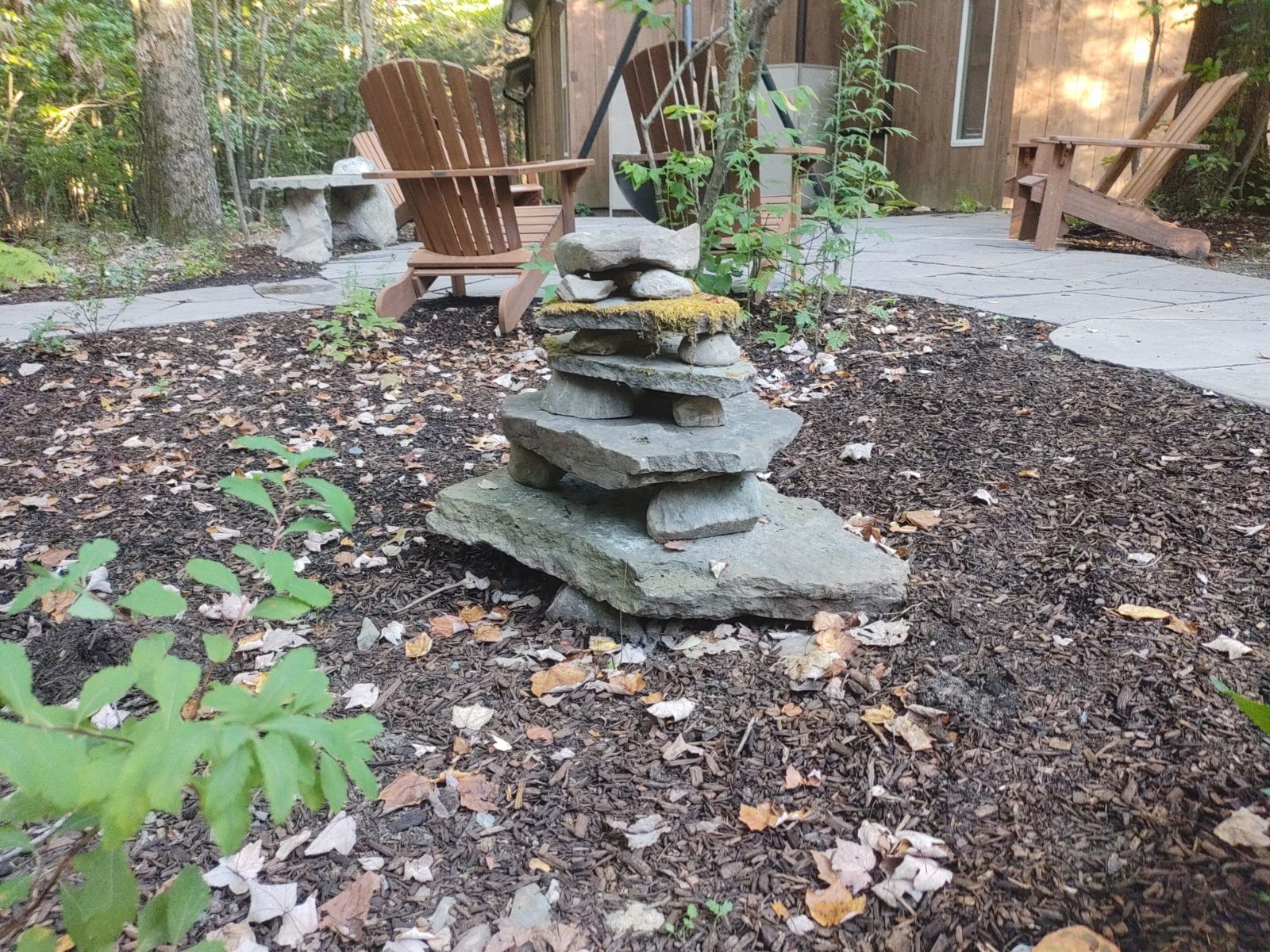
Small pagoda cairn with naturally bowl shaped top piece, where fruit and/or water may be left for pollinators.
Panpsychism
All of this stuff, is made of mind stuff. That is to say that panpsychism is a philosophy of mind in which mind is seen as a fundamental aspect of our reality. All of the natural world seems to exhibit consciousness, or mind-like aspects. If we’d used the term animism instead, then this listing would be at the top of the list, potentially scaring some people away too soon. But now we got ya, so you best read on.
Parapet
A low protective wall or railing along the edge of a raised structure such as a roof or balcony.
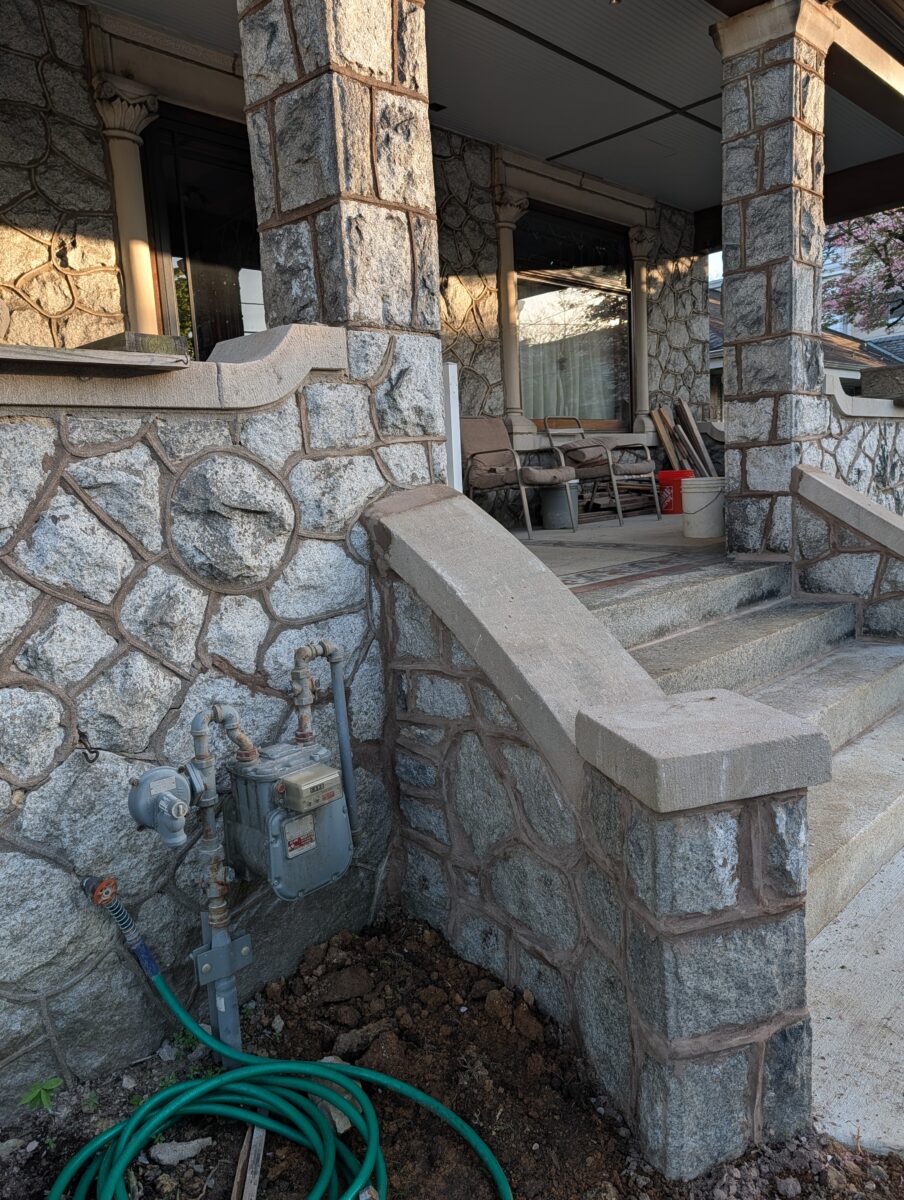
Parapet Wall, Masonry Restoration Work from a project in Allentown PA
Pebble Mosaic
An ephemeral version of mosaic art. Gather some pebbles, use them to draw a picture.
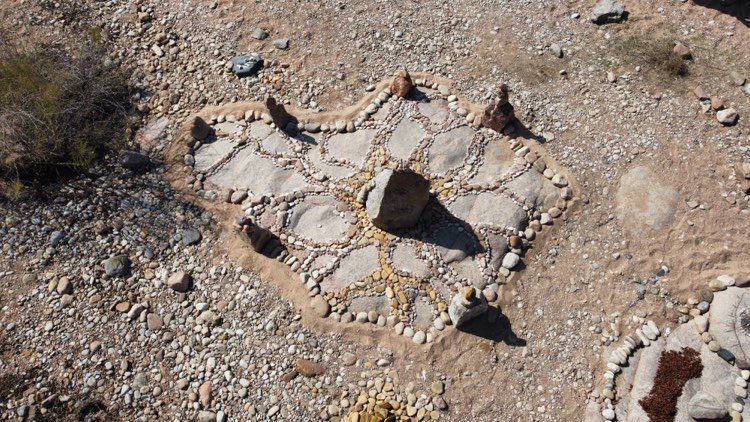
Pebble Mosaic, as seen from the sky.
Petroglyphs
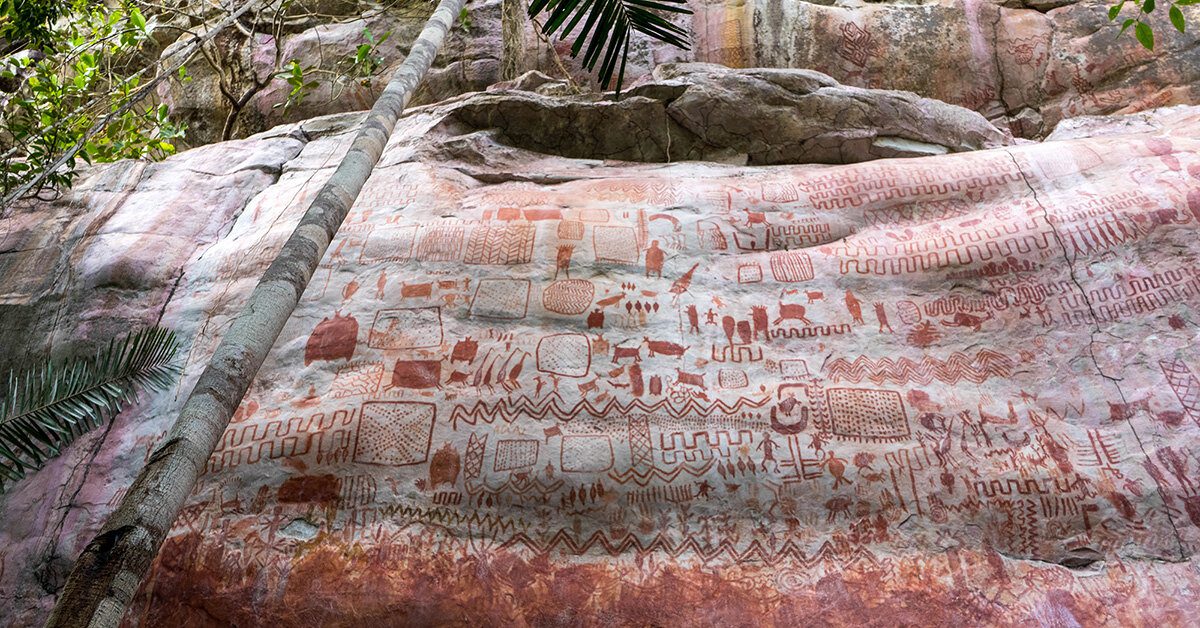
Ancient peoples scratched, engraved and otherwise carved figures unto stone surfaces. If someone tries telling you that carving, and land art, are two entirely different and completely separate disciplines–just shake your head. Not even worth your time, not even worth the breath, Just let them think that. No real harm’s being done and hey, maybe the world is a big enough place that two differing opinions could both be right.
But like the 18th Baron Dunsany, Edward James Drax Moreton Plunkett explained, in his classic novel the Charwoman’s Shadow:
All Art, is one art. When we learn any one art fully, we gain insight into all other arts, for they are but One.
–Lord Dunsany (paraphrased, from imperfect memory)
Pyramid
A Pyramid is a tapering stone structure. A natural way to arrange stones so that they stay put. It’s like the angle of repose: when you make a pile of soil, sand, or stone–it piles up like a cone. Different materials will settle at different angles of repose, for example an angular material will have a steeper angle of repose compared to a smooth/rounded material. Make that pile of material have a square base–and you’ll create a pyramid-like pile.
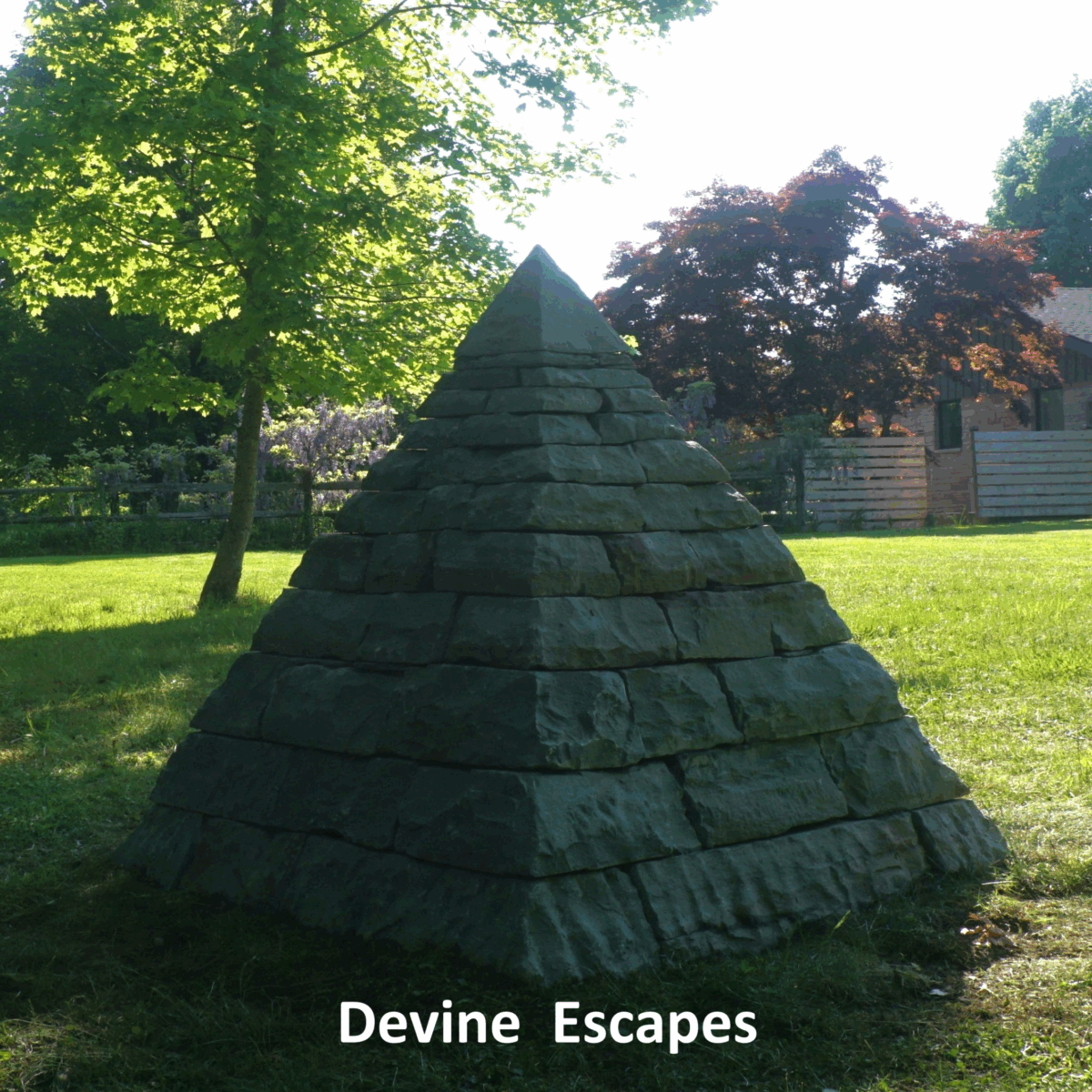
Did you know that at any given moment on the Planet Gaia there is something called Hole-Pile Equilibrium? A perfect balance–whenever you dig from a hole you increase its size, but also increase, in equal proportion, the corresponding pile. In this way the volume of holes on our planet is always equal to the volume of the piles.
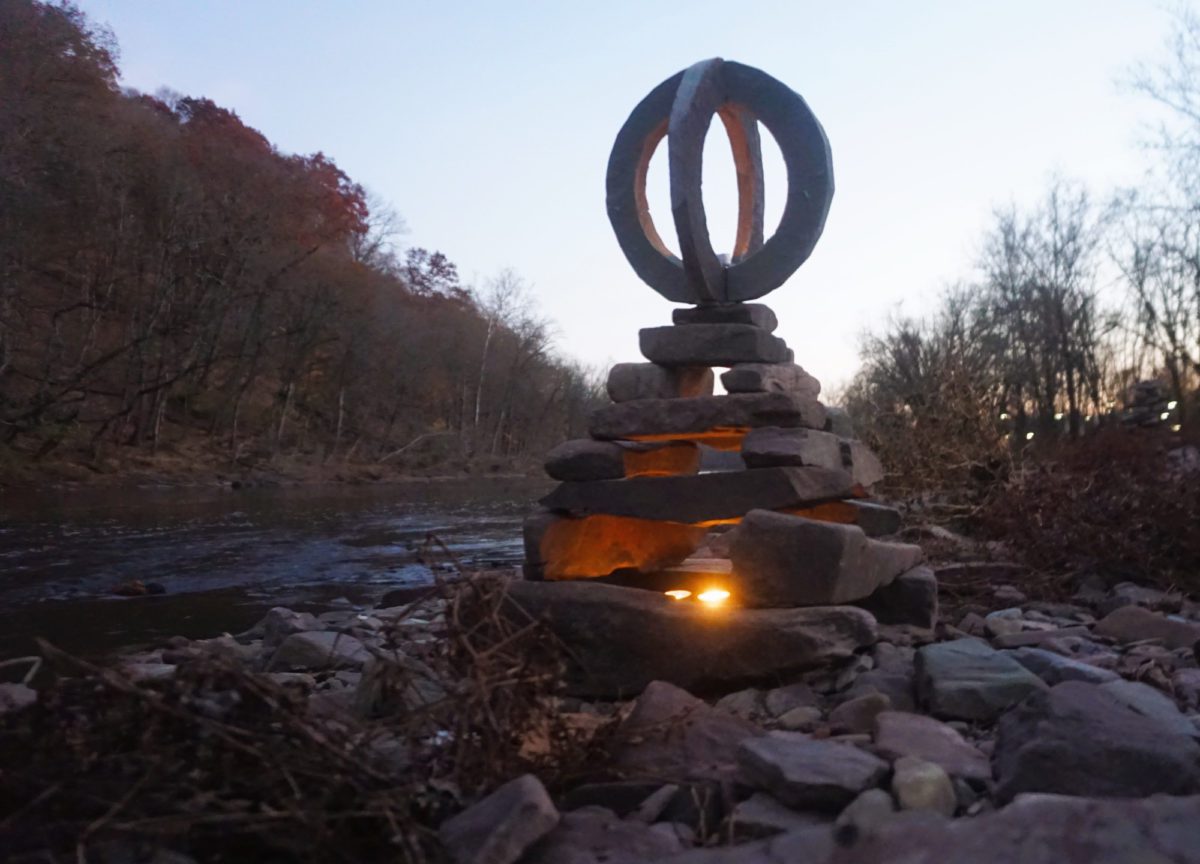
pyramid lantern
Sand Art
Sand castles, and drawings in the sand. If building castles, you want a good sand with lots of fines. Get the sand wet–but not too wet. Now sculpt!
Drawings in the sand, can be anything you want. Often, these are large geometrical figures. Strangely, the aliens like to take credit for the crop circle, but the nearly identical figures, done in sand? Yea, that’s just humans. Well, some of them humans are kind of odd. Might be an ingenious disguise!
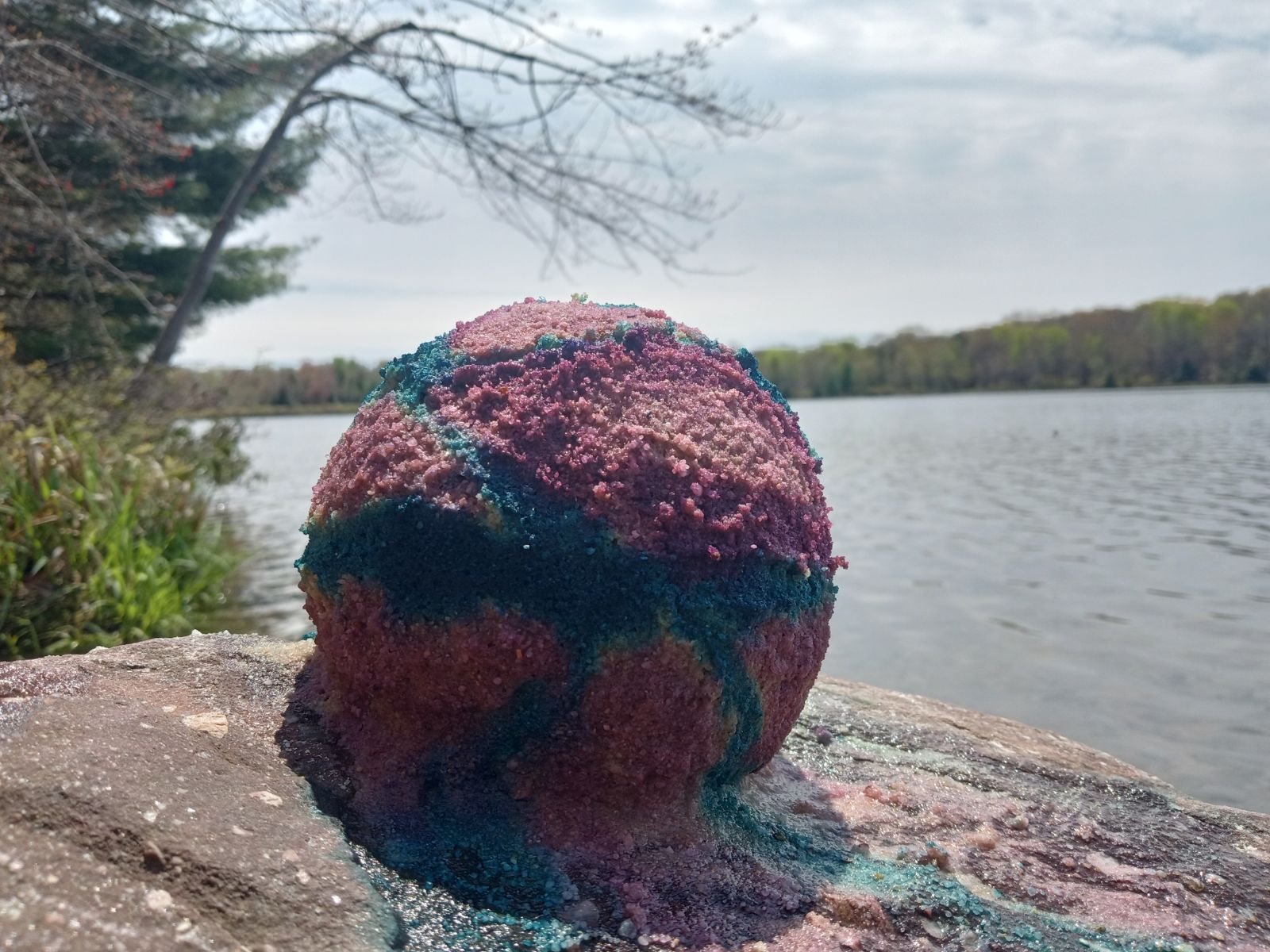
It’s like a dry stone sphere, but with smaller stones. Sort of.
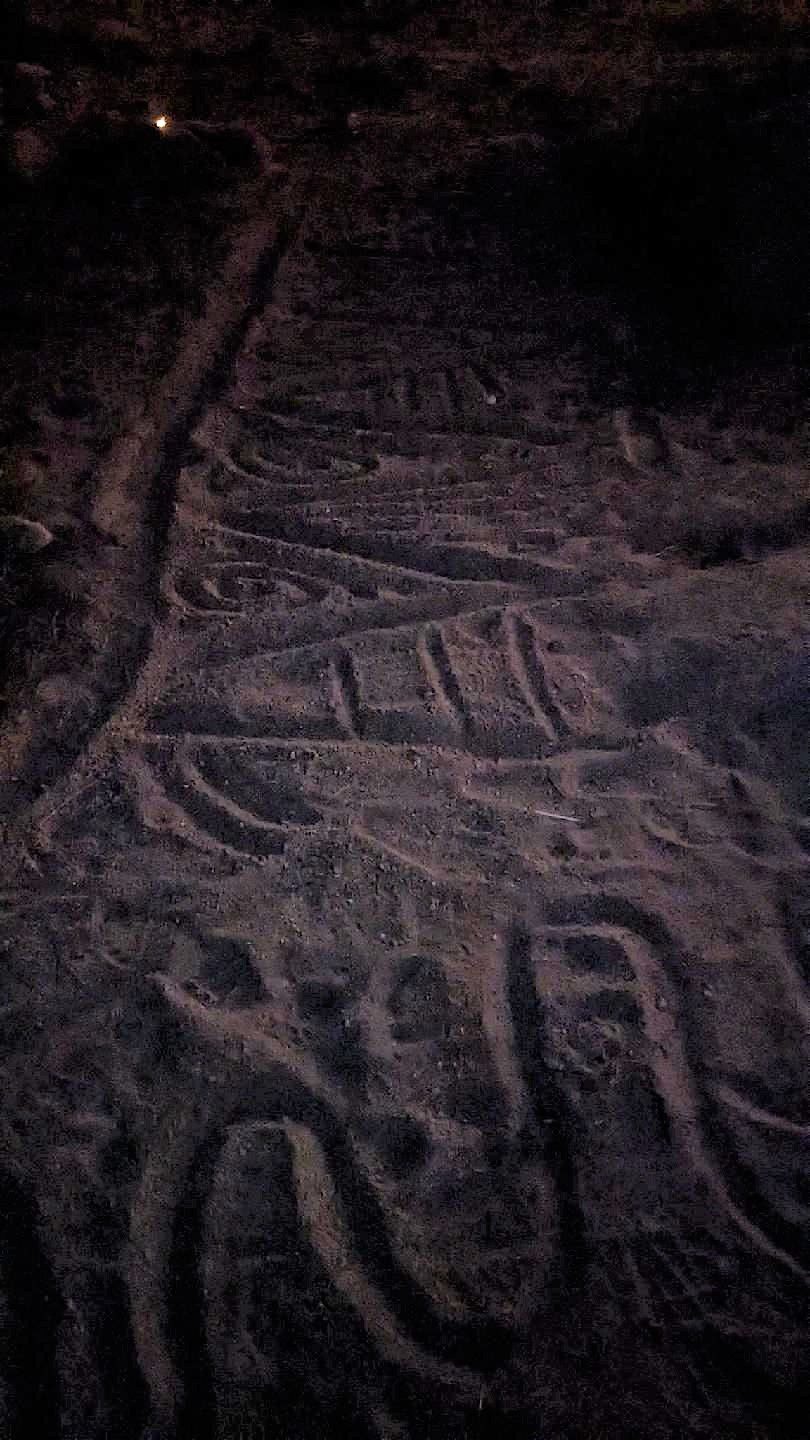
Late night sand art, apprentice work
Screenings
AKA pathway fines/quarry dust/ stone dust. The best leveling agent and joint material for dry set flagstone walkways and patios. This material is gravel in its smallest size, hence the term “screenings”–crushed stone is graded by being crushed and passed through screens. Screenings are those bits of crushed stone that pass through the smallest screen, the finest mesh. Generally this is sized as 1/4″ minus or 1/8″ minus, the “minus” referring to the fines, stone flour.
Silicate Paints
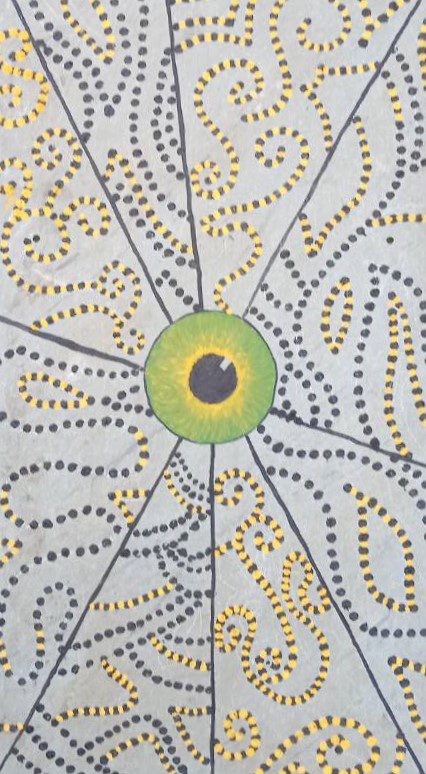
Sand is boiled in lye, carefully and with proper safety equipment–and this creates an amazing, eco-friendly and beautiful artistic medium. We don’t judge you for using acrylic paints–but we do offer free lessons, in how to create and use a non-polluting medium.
Slab
A broad flat stone with a much greater surface area than depth. For example, a flagstone is a type of slab. Contrast this with a cobble, which may also be used as a paving stone, but has a depth in similar range to its surface area.
Slate
Slate is considered a a type of mud rock. Mud rocks, are sedimentary stone comprised mostly of clay particles. Other types of mud rock include argilite and shale, both of which are common and easily located in Pennsylvania. The red, crumbly stone that you see on the side of the road, where they cut into the hillside–on route 76, 474, 422, and most of the other highways on the eastern half of the state–those are shale. Slate can be found in the wild, in the Lehigh River, at the Delaware water gap. There’s also a quarry–in Slatington Pa, which produces black slate.
But slate is a metamorphic rock, that was originally a mud rock. Slightly confusing right, that slate is considered a mud rock itself–but mud rock is sedimentary and slate is metamorphic. Well, I don’t know, but handling slate, you can clearly see and feel that it is similar to shale and argilite. So apparently the material was shale. And before being shale, it was clay. But The clay hardened into rock, and then millions of years or low pressure transforms that sedimentary stone into the metamorphic, slate.
Slate cleaves off in nice, flat planes, and is used commonly as a roofing material. In decades past, slate was commonly used as a flagstone material. In my work, I’ve used reclaimed roof slates, as a painting surface. Reclaimed slate flagstone, in green, red and purple, was quarried in Vermont. Back in the 60’s and 70’s they would use this tri-colored slate to build patios. I’ve reclaimed these colorful slates and incorporated them into many spheres and dry stone sculptures.
Sphere
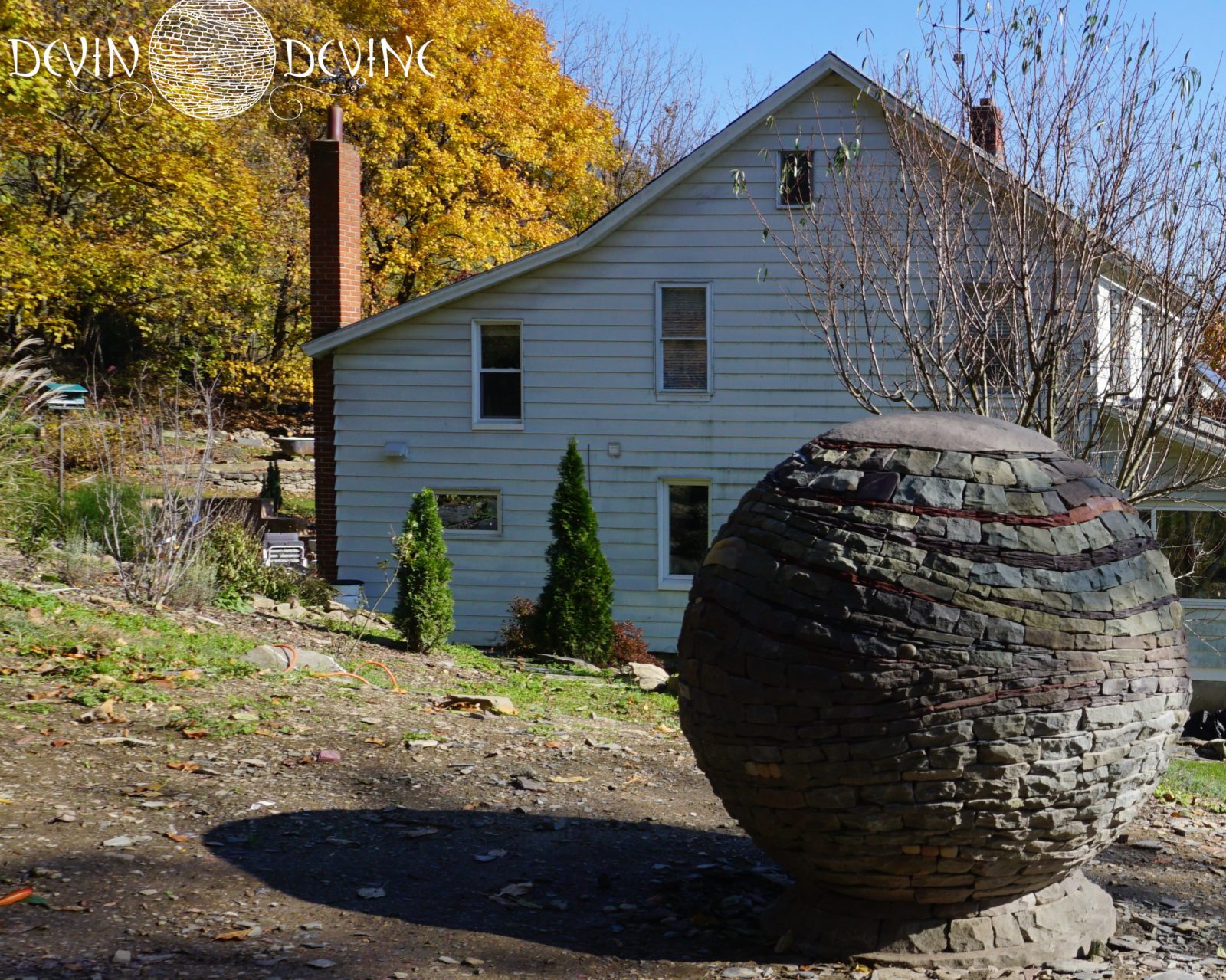
‘AKA Orb, or even “ball of stone”, the Sphere is the shape of our very Earth itself. A variety of stone types were used. The deeper red, and darker purple are both slate.
Spiral Herb Garden
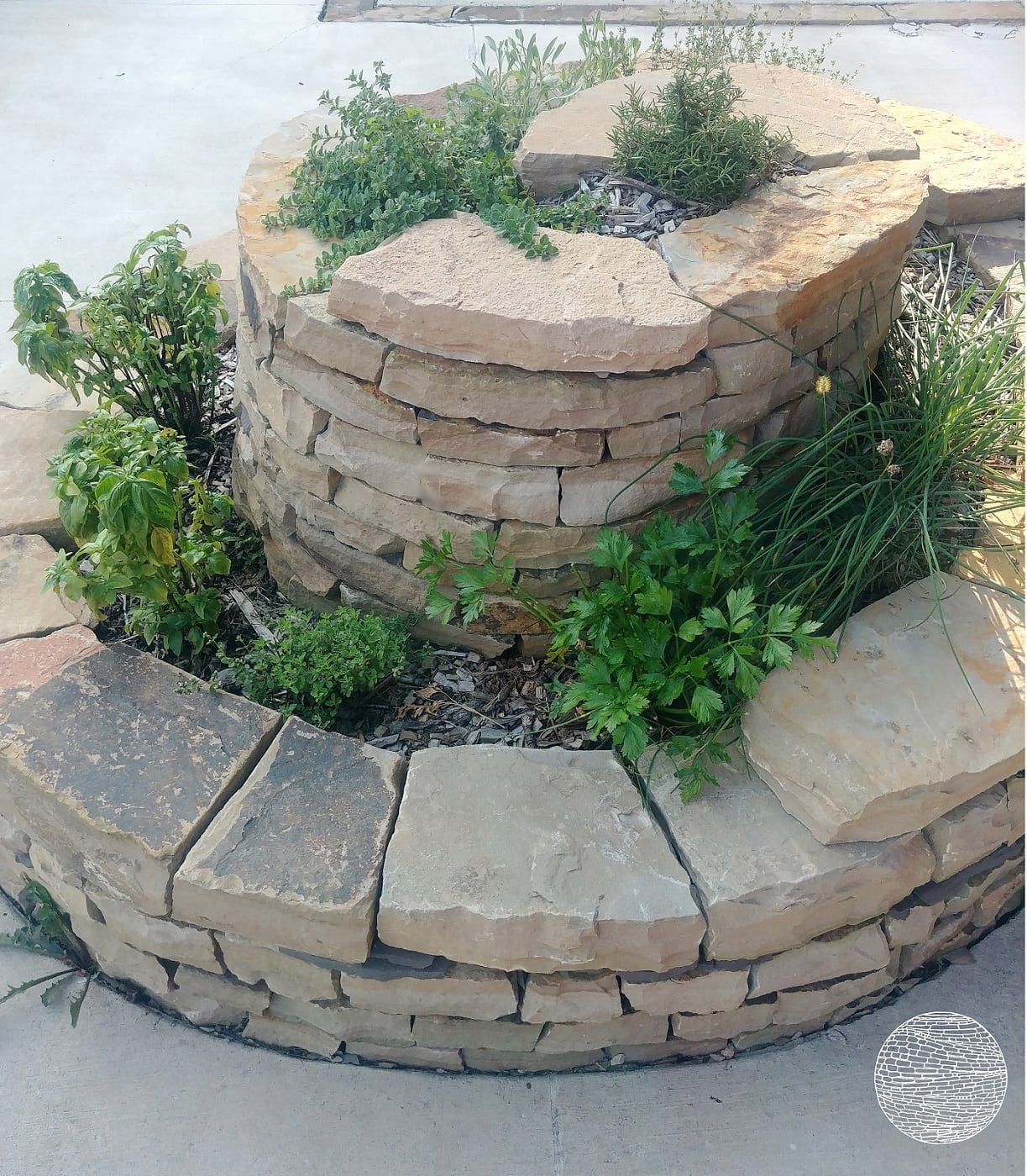
dry stone Spiral Herb Garden. A common enough permaculture garden feature. Usually, you’ll see flimsy versions of these, built with bricks, falling over and not much growing in them. But it is possible, to do ’em nicely.
the debil’s cream
Has no place, in a dry stone wall. Is unsuitable for joints on flagstone work that is built upon a gravel base. Is quite useful for repairing mortared work, building houses, and since 2017 I’ve been using it in my Lithadelic Sculptures, in a limited concealed capacity. These were originally built dry set, like my walls and patios, but especially for public works, it’s good to keep them secure against mishap.
Torus
A tours is Like a sphere, but on a higher dimensional plane. No this isn’t woo, but geometry. Take a circle and rotate it, to describe a sphere. Take a sphere and rotate it–to describe a torus. Do you see?
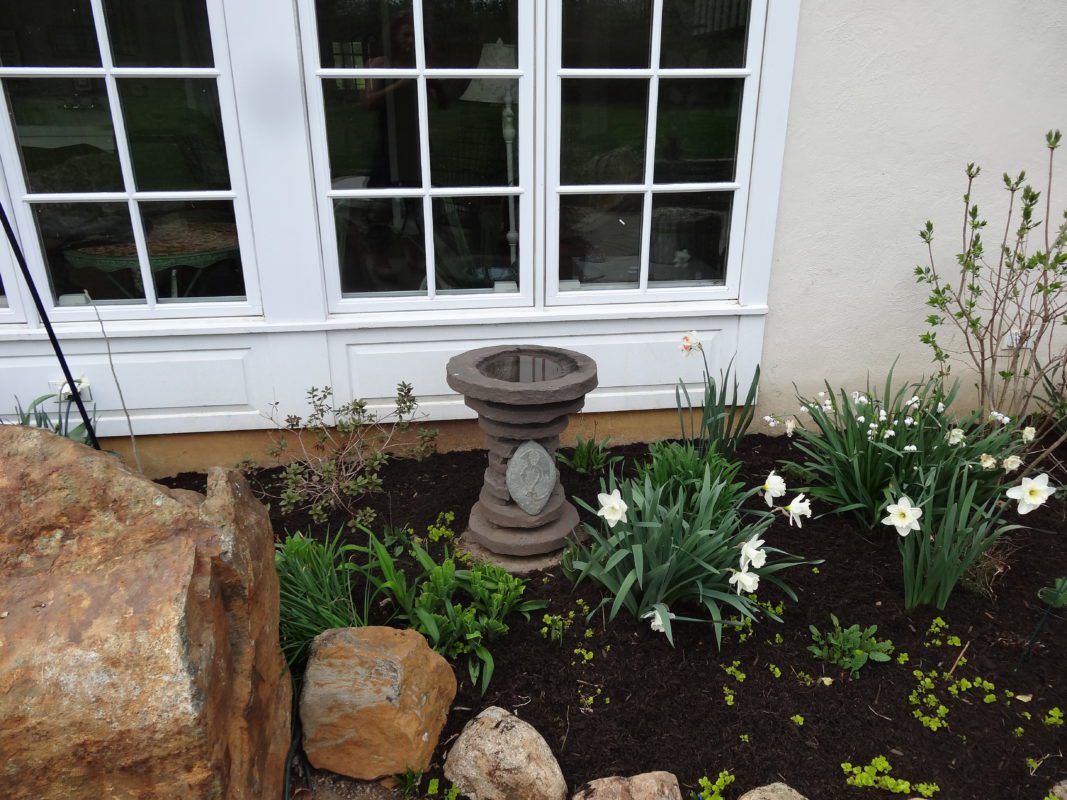
the first bird bath I ever built, circa 2011, was in toroidal form (and still is)
Scholar stones
AKA gonshi. Upright stones, specific to certain Asian traditions, of dolomitic and/or limestone basis, amazingly pocked, dimpled and intricate. The following is not an example, but is merely a “cool upright stone”.
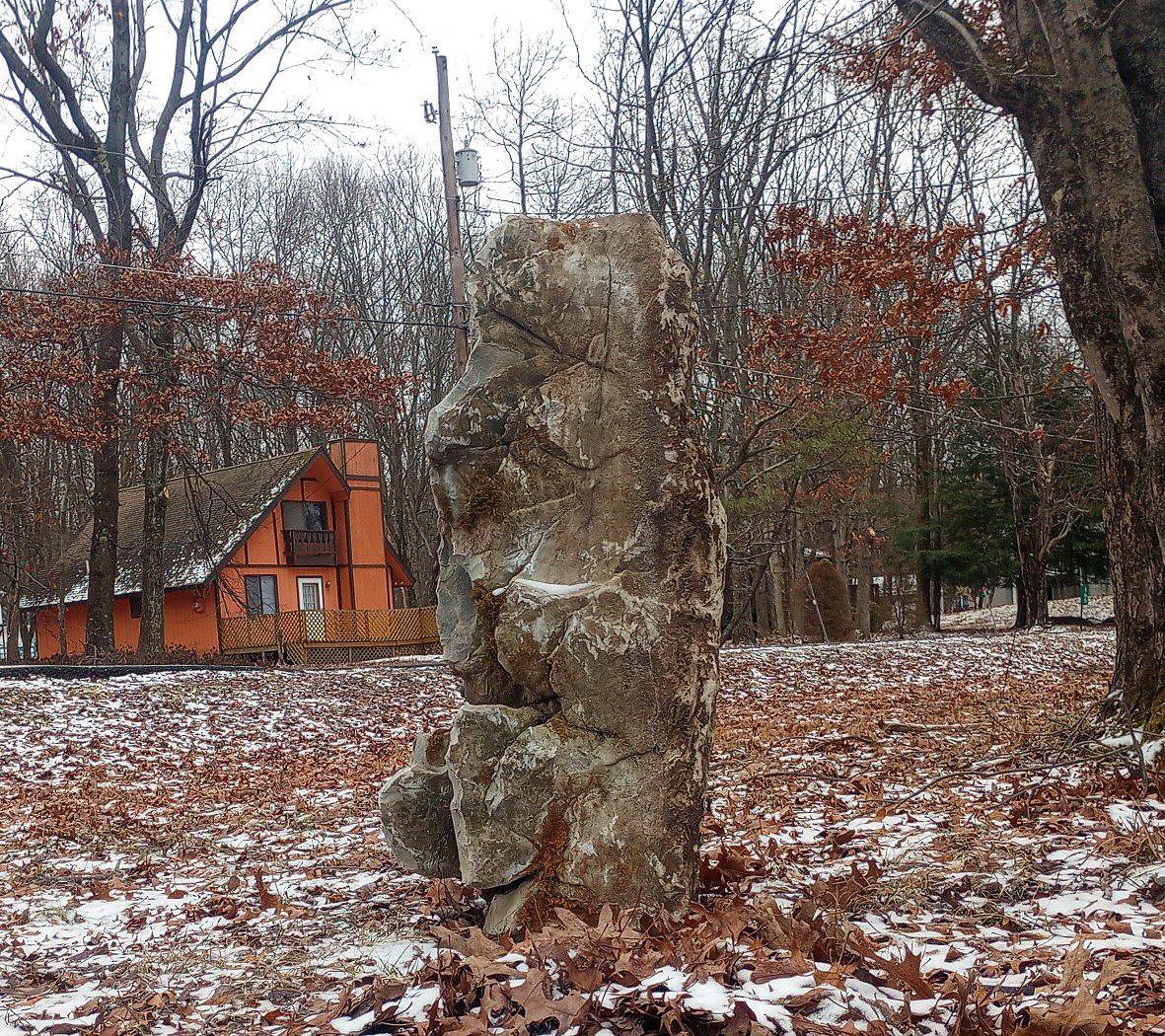
So beautiful. I dragged this mammy-jammy home, thinking bench, or birdbath. Nah–let’s just enjoy this ancient face, as is. ‘Nuff said.
Stacked Stone Sculpture
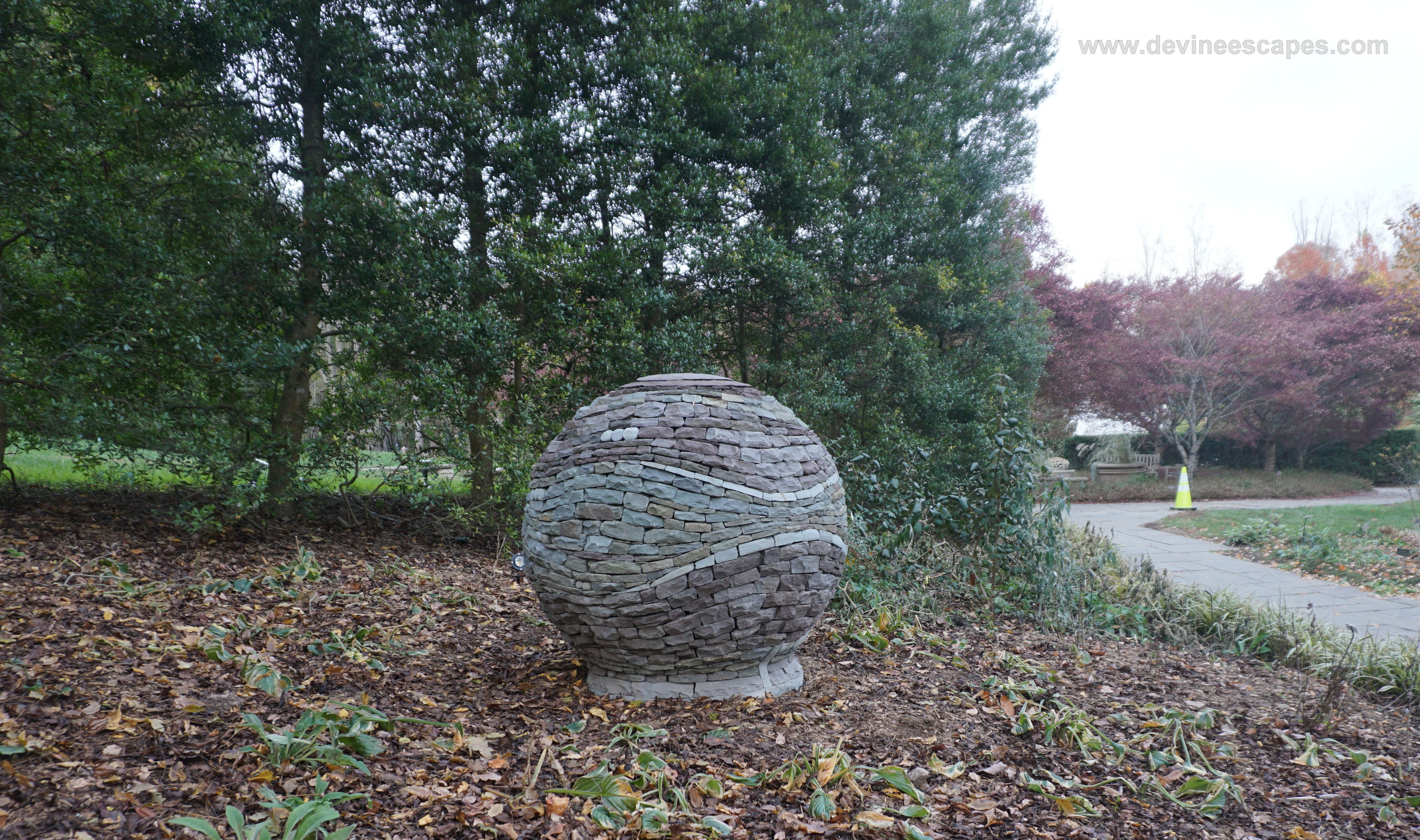
I’ve used this term to describe assemblage or additive style sculptural works. Like a dry stone sculpture–but not necessarily adhering to the rules of dry stone masonry. For example, if a customer wishes to have concealed cement, to protect a piece from vandalism. Or, if hidden pegs are used–if any major straying away from the conventions of dry stone walling, are employed, in the creation of a “Dry stone” sculpture–then the term stacked stone, is used, rather than “dry stone”. Too many (too many) of the viral posts that we see, proclaiming “DRY STONE”–are obviously not. You know who you are, and we both know you follow my blog, to harvest ideas from. Your work is cool, I’m not hating on you bro–but tell it true. Bro. Just tell it true.
Stick Weaving
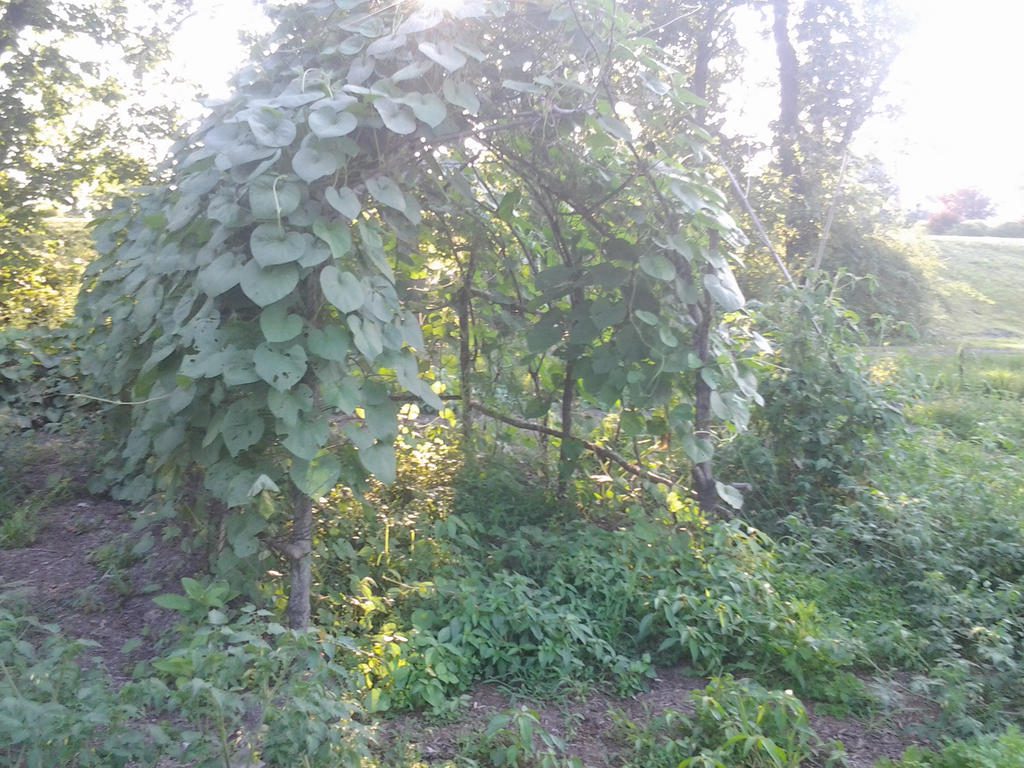
Houses, both simple, as this one–and much more elaborate and fanciful–have been fashioned from twigs and branches. Willow, bamboo and grapevine are considered choice materials, for their weave-ability. Other wood types are lovely and/or useful, for other reasons. Shown above: bean house. A trellis for the beans–and a cool place in the summer.
Vase
A vessel for growing plants.
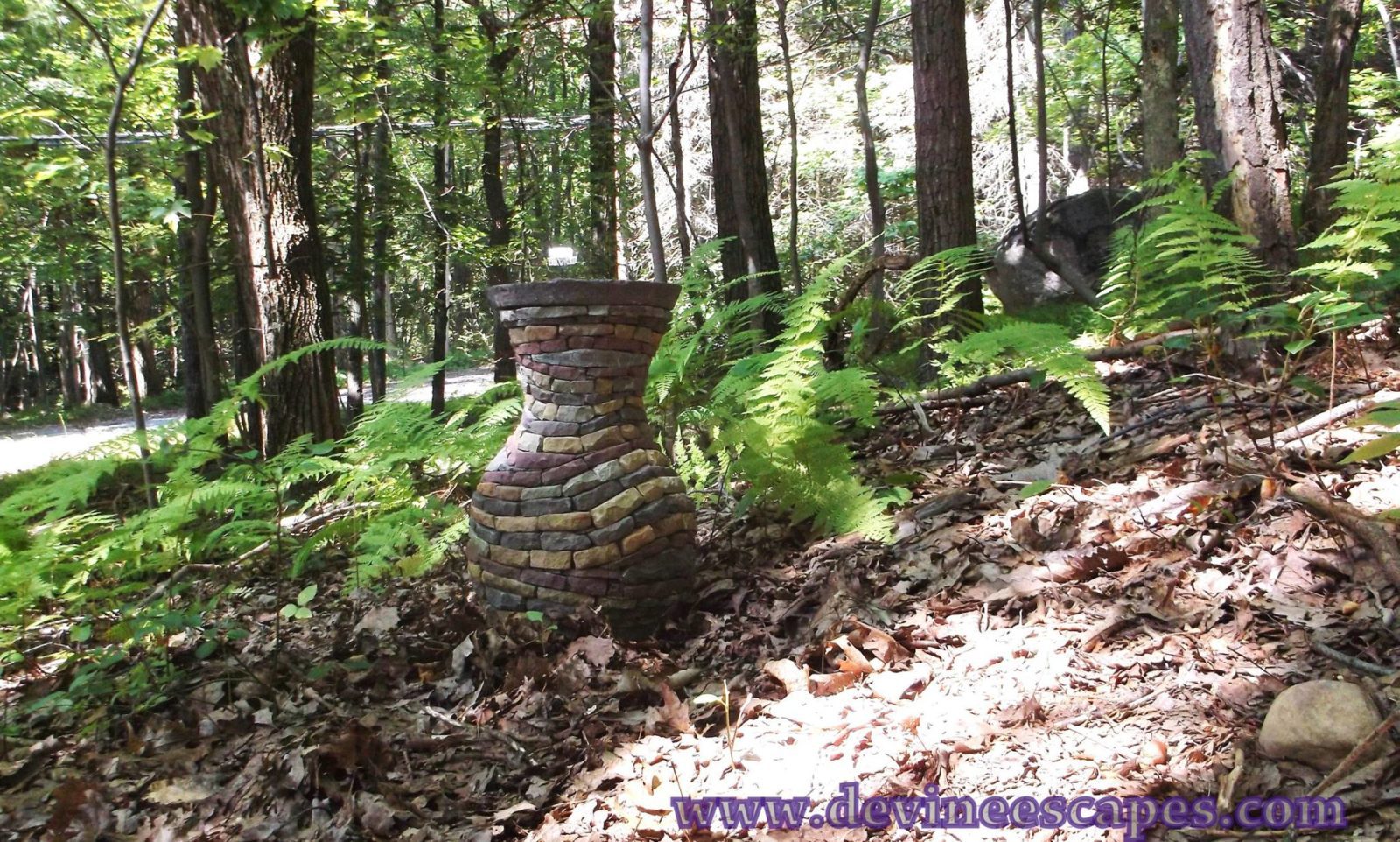
This one is purely sculptural, not an actual vase
Vernacular Architecture
There’s 2 definitions to this word. Vernacular refers to terminology and vocabulary. But it also refers to regional building styles. In fact. vernacular architecture is often used interchangeably with natural building. Vernacular, here, refers to the local styles that have built up and proven themselves, over time, without the help of engineers.
Voussoir
Wedge shaped stones that make up the main body of an arch. Want to sound fancy? Don’t call them “arch stones”, call them voussoirs
Walling
the act of building dry stone walls.
Thank You
The concepts in this lexicon overlap through dry stone masonry, landscape design, sculpture, architecture and natural building. This page will expand over time as new terminology, techniques and artistic concepts emerge through ongoing projects and experimentation
Note: this list is not comprehensive. More of a first draft, at this point. Feel free to use the comment section to fill me in, on any major omissions that should have been included.

Trackbacks/Pingbacks